A lot of advertisers look at BM50 vs BM2500 and assume the choice is simple.
They see a larger number, imagine more capacity, and conclude that BM2500 must be the better Business Manager.
In practice, that is usually the wrong way to think about it.
The real question is not which BM looks bigger. The real question is when a business actually needs enterprise BM infrastructure.
If you need the broader foundation first, start with the main guide to Facebook Business Manager and the supporting article on Facebook Business Manager Explained.
This article focuses on a narrower decision: when BM50 is enough, when BM2500 becomes relevant, and what kind of business is actually ready to use enterprise BM infrastructure properly.
AdsTrust’s BM lifecycle content places BM50 in the structured scaling stage, while BM2500 is positioned at the enterprise-level operations stage for large companies and agencies operating at serious scale.
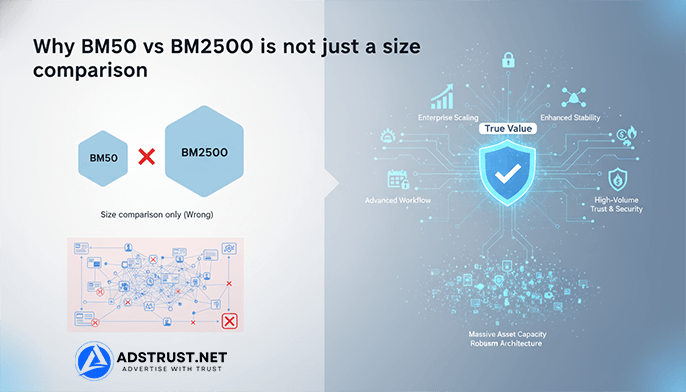
Why BM50 vs BM2500 Facebook is not just a size comparison
This is where many buyers get misled.
AdsTrust’s BM guide is very clear that BM numbers describe capacity, not resilience.
The guide explicitly warns against the “bigger is better” mindset and says professionals choose BM size based on intended usage such as testing, scaling, asset isolation, or long-term brand operations.
A BM with 50 ad account slots is not automatically safer than a smaller BM, and the same logic applies when people jump from BM50 to BM2500 too early.
So BM50 vs BM2500 is not really a question of “more is better.”
It is a question of operational fit.
A business should move toward enterprise BM infrastructure only when the business itself has become enterprise in the way it operates.
What BM50 Facebook is actually for

BM50 is best understood as a high-capacity structure for scalable operations, not as an enterprise symbol.
AdsTrust positions BM50 as a 50-ad-account Business Manager designed for scalable Meta advertising, asset isolation, and long-term system stability.
The BM lifecycle article also places BM50 in the stage where segmentation becomes essential for advertisers managing multiple campaigns, offers, or markets.
That tells you a lot about where BM50 fits.
BM50 usually makes sense when the business already has enough moving parts to justify a larger structure,
But is still operating within a scope that can be managed as a structured scaling system.
It is often suitable for agencies, multi-campaign advertisers,
And businesses that need more room for organized execution without necessarily requiring enterprise-grade infrastructure.
BM50 is large, but it is still a structure many serious operators can understand and manage cleanly.
What BM2500 Facebook is actually for
BM2500 belongs in a different category.
AdsTrust’s BM explained page places BM2500 in Stage 5: Enterprise-Level Operations and describes it as infrastructure for agencies and large companies that need massive capacity, priority trust, and predictable escalation paths.
The same page explicitly calls BM2500 “enterprise infrastructure,” notes that it is limited in availability, and says it is designed for organizations operating at serious scale.
That language matters.
BM2500 is not just a larger BM50. It is meant for a different kind of operational reality.
A business considering BM2500 should already understand complex asset structures, layered execution, high-volume operational discipline, and long-term infrastructure planning.
If BM50 is about scale with structure, BM2500 is about scale with enterprise-level system requirements.
BM50 vs BM2500 Faceboook: the real operating difference
The real difference is not the raw number.
The real difference is the level of system complexity the business can justify and manage well.
BM50 is usually for structured scaling
BM50 makes sense when the business needs serious segmentation, multiple campaign lanes, and better asset isolation, but still wants a structure that remains understandable at the operator level.
That often includes: one brand with many campaign groups, multiple markets under one coherent system,
or an agency that needs broader execution capacity without moving into true enterprise infrastructure.
In that stage, BM50 can be a very strong fit because it supports scale without forcing the business into a system it is not mature enough to use properly.
BM2500 is usually for enterprise operations
BM2500 makes sense when the business no longer has a simple scaling problem.
It has an infrastructure problem.
At that point, the business may need very high capacity, more predictable escalation, broader internal separation, or a structure built for serious ongoing operations across many assets or business layers.
That is the exact role AdsTrust describes for BM2500 in its BM lifecycle content.
This is why BM2500 should not be treated as a prestige upgrade.
It is a tool for a different operating stage.
When BM50 Facebook is still enough
A lot of businesses do not need BM2500, even when they think they do.
BM50 is often still enough when the business is scaling hard but remains operationally coherent.
If the team can still explain who owns what, why assets are grouped the way they are, and how campaigns are segmented, BM50 may continue to be the right structure.
This is especially true for advertisers who mainly need:
cleaner asset isolation, more room for parallel execution, and better long-term organization than BM10 or BM5 can comfortably support.
That is exactly why BM50 exists in the lifecycle between structured scaling and enterprise operations.
When BM2500 Facebook starts becoming relevant
BM2500 becomes relevant when the business has clearly moved beyond “large advertiser” territory and into infrastructure-heavy operations.
That usually means the organization is no longer solving a simple capacity issue.
It is solving for scale discipline, operational layering, and enterprise continuity.
AdsTrust’s BM explained page specifically ties BM2500 to agencies and large companies that need massive capacity and predictable escalation paths,
which is a much narrower use case than most buyers initially imagine.
A business is often closer to BM2500 territory when: its operational scale is already serious, its internal structure is layered,
And its current BM environment feels limited not because of poor management
But because the business itself has genuinely reached a higher level of infrastructure demand.
That is a very different situation from simply wanting “more room.”
The hidden mistake: buying BM2500 Facebook for fantasy scale
This is one of the easiest mistakes to make.
A business imagines future scale and buys toward that fantasy instead of its current operating reality.
The problem is that enterprise infrastructure does not automatically create enterprise discipline.
If the company does not already know how to manage assets, permissions, segmentation, and pacing cleanly, a BM2500 usually becomes a larger space for the same bad habits.
AdsTrust’s BM guide warns directly against choosing BM size based on fantasy rather than intended usage.
That warning becomes even more important at the BM2500 level.
The safest way to grow is not to buy the biggest number.
It is to use the right structure for the stage you are actually in.
BM50 vs BM2500 for agencies
Agencies often understand this difference better than brands, because they feel the pressure of system design earlier.
A serious agency may genuinely need BM50 for scalable client operations, segmentation, and asset isolation.
But BM2500 only starts making sense when the agency’s workflow, team structure, and operational scale have already moved into enterprise territory.
This also connects naturally with the earlier roadmap article on shared Facebook Business Manager vs owned BM.
Some agencies need more than capacity. They need the right ownership model and infrastructure logic for the type of work they actually do.
An agency that chooses BM2500 too early is not becoming more advanced.
It is usually becoming more complicated than necessary.
BM50 vs BM2500 Facebook for brands
For brands, the threshold is often even higher.
A growing brand may absolutely benefit from BM50 if it has multiple campaigns, asset separation needs, and a long-term scaling plan.
But BM2500 is rarely about brand ambition alone. It is about brand complexity at a much higher operating level.
Many brands that think they need BM2500 are actually dealing with a different issue.
Sometimes they need a cleaner owned structure, not a more extreme capacity tier.
In those cases, a verified Facebook Business Manager may be more relevant than jumping immediately toward enterprise infrastructure.
AdsTrust positions verified BM as a trust-first foundation that businesses build on properly, rather than as a shortcut to instant large-scale operations.
A cleaner way to choose
If you are deciding between BM50 and BM2500, ignore the temptation to think in status language.
Instead, ask quieter questions.
Is BM50 no longer enough because the business is truly enterprise in structure?
Does the company already operate with the discipline needed for enterprise BM infrastructure?
Is the real need massive capacity, or simply better architecture?
Would BM2500 reduce operational friction, or just increase complexity?
Those questions usually lead to better decisions than comparing BM numbers in isolation.
Final Thoughts
So, BM50 vs BM2500: when does a business need enterprise BM infrastructure?
Usually only when the business itself has become enterprise in the way it operates.
BM50 is often the right fit for structured scaling, asset isolation, and serious multi-campaign execution.
BM2500 is relevant when the company needs massive capacity and enterprise-grade infrastructure because its operational reality has genuinely reached that level.
The mistake is not choosing BM50 or BM2500.
The mistake is choosing enterprise infrastructure before the business is ready to use it well.
In Meta operations, the strongest structure is rarely the one with the largest number.
It is the one that matches the real shape of the business.