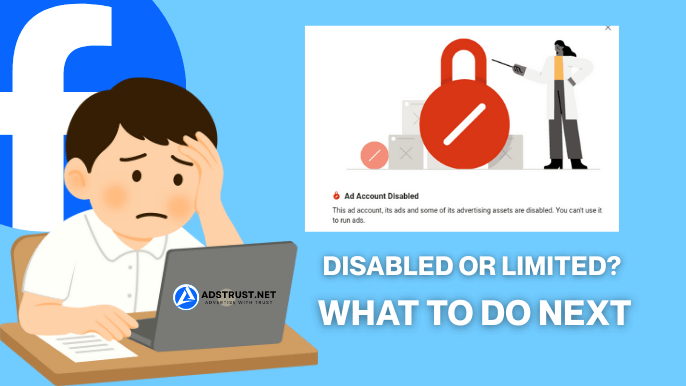
If your Facebook ad account has been disabled or suddenly hit a spending limit, you’re not alone.
This situation happens to new advertisers, experienced media buyers, agencies, and even brands that have been running ads for years.
And despite what Facebook’s notifications suggest, it’s rarely caused by a single mistake.
The bigger problem is that most advertisers don’t actually understand what Facebook is reacting to, or what options still exist once restrictions appear.
This article breaks it down calmly and clearly — without panic, without hype.
What “Facebook Ad Account Disabled” or “Limited” Really Means
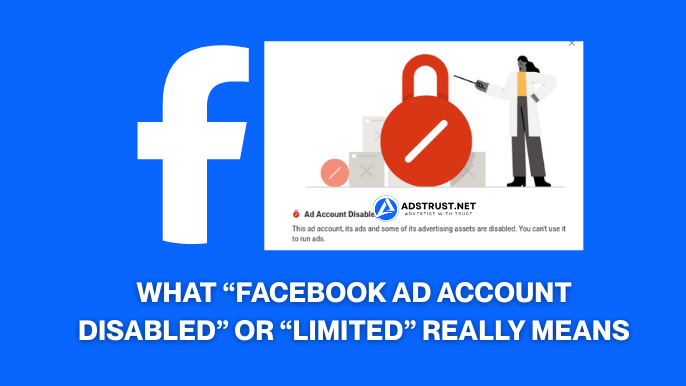
When Facebook disables or limits an ad account, it doesn’t always mean you violated a policy.
In many cases, it means Facebook’s system no longer feels confident about the ad account environment — not just the ads themselves.
That environment includes:
- how the ad account was created
- the Business Manager it belongs to
- the fanpage used for ad delivery
- payment behavior and early spending patterns
A sudden restriction is often a signal that trust was never fully established in the first place.
Why Facebook New Ad Accounts Get Restricted So Easily
Facebook new ad accounts are fragile by design.
They start with:
- low spending thresholds
- limited historical data
- higher sensitivity to behavioral signals
When spending ramps up too quickly, or when assets are combined inconsistently, Facebook reacts conservatively.
This is why many advertisers see limits or bans before campaigns even stabilize.
Why Appeals Often Don’t Solve the Real Problem
Appealing a disabled ad account can work — but it often doesn’t.
The reason is simple: appeals address policy decisions, not structural weaknesses.
If the surrounding setup (Business Manager, fanpage, Facebook profiles) remains weak, reinstated accounts frequently face restrictions again later.
Appeals treat the symptom, not the system.
What Options Do You Actually Have After a Restriction?
At this point, advertisers usually fall into two groups.
Some try to rebuild everything from scratch and repeat the same process.
Others step back and rethink how Facebook expects accounts to mature.
This is where shared advertising infrastructure becomes relevant.
Instead of creating new ad accounts in low-trust environments, many advertisers choose to operate inside existing, stable structures.
To understand how these structures work, this overview explains Facebook ad accounts in detail:
When Controlled Accounts Make More Sense
For advertisers who are testing, warming, or recovering from a restriction, controlled environments often reduce friction.
Shared ad accounts with defined limits allow campaigns to run without forcing aggressive early behavior.
This approach is commonly used before scaling again.
You can see how controlled shared accounts work here: Facebook Ad Accounts Share ($250 Daily Limit)
When Scaling Requires a Different Environment
If campaigns are already validated and the issue is purely structural, higher-trust environments may be more appropriate.
Enterprise-level setups remove many of the early-stage constraints that trigger repeated limits.
This is typically where mature advertisers or agencies transition once testing is complete: Facebook Ad Accounts Share BM2500 (No Limit, Enterprise)
How Facebook Fanpages and Business Managers Affect Ad Account Health
Facebook Ad accounts don’t exist in isolation.
They rely on:
- the Facebook fanpage delivering ads
- the Facebook Business Manager controlling access
- profiles managing permissions
A mismatch between these elements often increases risk.
If you want a clearer picture of how fanpages influence ad account behavior
This guide explains the relationship in detail: Facebook Fanpage Explained: New vs Aged vs Verified Pages
Final Thoughts — Think in Systems, Not Single Accounts
Facebook advertising becomes much more predictable when you stop treating ad accounts as disposable.
Restrictions are usually a signal that the system around the account needs attention — not just the ads.
By understanding how limits work and choosing the right infrastructure at each stage, advertisers can reduce interruptions and regain control over scaling.