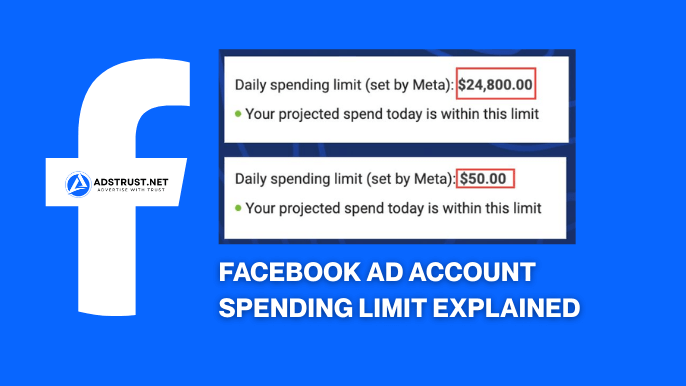
If you have ever seen a message saying your Facebook ad account has a daily spending limit.
You have probably asked the same question most advertisers do:
“Why does Facebook limit my spending when I’m trying to spend more?”
The short answer is that spending limits are not a punishment.
They are part of how Facebook manages risk — especially for newer or recently changed ad accounts.
Understanding how these limits work helps advertisers stop guessing and start making decisions that align with how the system actually behaves.
What is a Facebook Ad Account Spending Limit?
A spending limit is a cap on how much an ad account can spend within a given period, usually per day.
This limit is not fixed forever. It is a control mechanism that Facebook uses to evaluate:
- payment reliability
- account behavior consistency
- overall trust of the surrounding setup
The key point most advertisers miss is that spending limits are influenced by more than just the ad account itself.
Why Facebook Applies Spending Limits in the First Place
Facebook operates on a risk-based model.
When an ad account is new, recently modified, or connected to unfamiliar assets, Facebook limits exposure until it sees predictable behavior.
This protects both Facebook and advertisers from sudden losses caused by fraud, chargebacks, or unstable setups.
Limits often appear after:
- creating a new ad account
- switching payment methods
- changing Business Manager ownership
- attaching a new fanpage
These changes reset trust signals more often than people realize.
How Spending Limits Increase Over Time
There is no button you can press to instantly raise a spending limit.
Limits usually increase gradually when Facebook observes:
- consistent daily spending
- successful payment processing
- stable campaign behavior
This process can take weeks or months, depending on how conservative the system is with a particular setup.
This is why many advertisers feel “stuck” even when campaigns perform well.
What Most Advertisers Get Wrong About Spending Limits
One common mistake is assuming that good performance alone will remove limits.
Performance matters, but structure matters more.
Ad accounts that are placed inside weak environments — such as low-trust Facebook Business Managers or newly created fanpages — often remain limited even when campaigns convert well.
Another mistake is trying to bypass limits too aggressively, which often leads to new restrictions instead of progress.
How Account Structure Affects Spending Capacity
Ad accounts do not operate independently.
They are connected to:
- Business Managers that govern permissions
- fanpages that deliver ads
- profiles that control access
If any of these elements lacks trust or history, the ad account inherits that risk.
This is why some advertisers experience limits repeatedly, even after creating multiple new ad accounts.
For a deeper explanation of how ad accounts fit into the overall system, see this guide: Facebook Ads Accounts Explained: Limits, Sharing & Scaling
When Controlled Ad Accounts Are a Practical Choice
For advertisers who want predictable spending behavior, controlled environments often make sense.
Shared ad accounts with predefined limits allow campaigns to run without forcing early-stage trust building from scratch.
This approach is commonly used during testing or recovery phases.
You can see how limited shared ad accounts work here: Buy Facebook Ad Accounts Share ($250 Daily Limit)
When Spending Limits Are No Longer the Real Issue
At a certain stage, the problem is no longer the limit itself.
Advertisers who have validated campaigns often find that spending limits become the bottleneck rather than performance.
In these cases, operating within higher-trust environments removes unnecessary constraints.
This is typically where enterprise-level shared setups are used: Buy Facebook Ad Accounts Share BM2500 (No Limit, Enterprise)
Final Thoughts — Work With the System, Not Against It
Spending limits are not a flaw in Facebook’s advertising platform.
They are a signal — one that tells you how much trust the system currently assigns to your setup.
Advertisers who understand this can choose the right structure at the right time, instead of fighting limits repeatedly.
When structure aligns with intent, scaling becomes smoother and more predictable.