A surprisingly large number of advertisers still use the terms Facebook ad account and Business Manager as if they mean the same thing.
They do not. This confusion creates real problems.
People try to solve Business Manager issues by changing ad accounts.
Others assume a healthy ad account means the surrounding structure is healthy too.
In practice, that misunderstanding often leads to unstable setups, unnecessary restrictions, and poor decisions when scaling.
If you want to understand how Facebook advertising infrastructure really works, this distinction is one of the first things to get right.
What a Facebook Ad Account Actually Is
A Facebook ad account is the place where campaigns are created, budgets are set, billing is processed, and performance is measured.
It is the execution layer.
When advertisers launch campaigns, adjust spending, duplicate ad sets, or review performance metrics, they are working inside the ad account.
It is the operational surface of Facebook advertising.
But despite how visible it is, the ad account is only one part of a larger system.
For a broader explanation of how ad account structures work, including limited and shared environments, see:
Facebook Ads Accounts Explained: Limits, Sharing & Scaling
What a Business Manager Actually Is
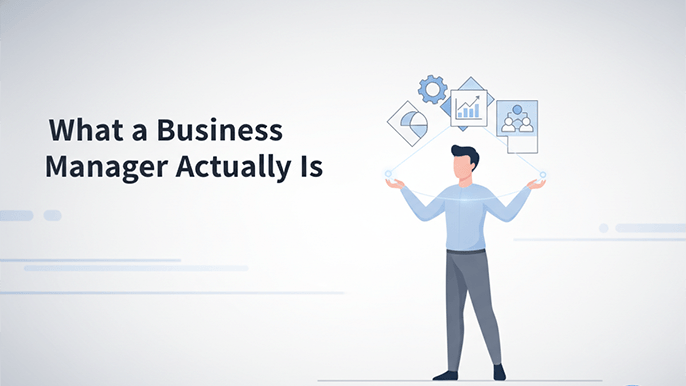
A Business Manager is the structure that controls ownership, permissions, and relationships between assets.
It is the governance layer.
Business Manager does not run ads directly. Instead, it holds the assets that make advertising possible.
These usually include ad accounts, fanpages, domains, pixels, payment responsibilities, and user permissions.
In simple terms, if the ad account is where the work happens, the Business Manager is where the system is organized.
A full breakdown of BM structure and lifecycle is here: Facebook Business Manager Explained: Types, Limits & Safe Usage Guide
Why So Many Advertisers Mix Them Up
The confusion usually comes from how Facebook presents the interface.
New advertisers often create an ad account and a Business Manager within the same setup flow.
Because both appear around the same time, they assume both are just different names for the same thing.
The platform also hides a lot of structural logic behind simple menus.
That makes it easy to miss the fact that one layer manages spending while the other manages control.
The result is that advertisers often diagnose the wrong problem.
How the Two Layers Work Together
An ad account usually lives inside a Business Manager.
That relationship matters because the Business Manager influences how much trust Facebook assigns to the ad account.
A strong account operating inside a weak BM can still experience friction.
Likewise, a well-structured BM can make ad account behavior more stable over time.
This is one reason some advertisers become frustrated when campaigns perform well but limits still remain tight.
They are evaluating the ad account in isolation while Facebook is evaluating the entire environment.
When the Real Problem Is the Business Manager, Not the Ad Account
Many advertisers assume that if ads stop scaling, the ad account itself must be the problem.
That is not always true.
Sometimes the underlying issue is that the Business Manager is too new, poorly structured, weakly verified, or overloaded relative to its trust level.
In those cases, changing campaigns or creating a fresh ad account often does not solve anything.
The new account simply inherits the same structural weaknesses.
This is why mature advertisers think in layers, not just in accounts.
For the full category of Business Manager options, see: Business Manager
When the Ad Account Is the Real Bottleneck
There are also situations where the Business Manager is fine, but the ad account itself remains the limiting factor.
This usually appears through:
- daily spending caps
- repeated billing friction
- account-level policy reviews
- unstable campaign learning phases
In those cases, the advertiser may need a more suitable ad account environment rather than a different BM structure.
The available ad account category for AdsTrust is here: Facebook Ads Accounts
Why This Difference Matters for Scaling
If you do not know whether the problem lives in the ad account or the Business Manager, you end up changing the wrong part of the system.
That mistake is expensive.
Advertisers waste time rebuilding assets that were not broken, or they keep forcing spend through ad accounts that are sitting inside weak governance structures.
Over time, this leads to more resets, more restrictions, and less predictable scaling.
Understanding the difference between these two layers makes every later decision better.
How Fanpages Fit Into the Same Structure
Fanpages add another layer to this system.
They do not replace ad accounts or Business Managers, but they influence how the whole structure behaves.
Weak page history, unstable ownership, or poor page trust can undermine both the ad account and the BM environment around it.
A detailed explanation of how new, aged, and verified pages fit into the system is here: Buy Facebook Fanpage Explained: New vs Aged vs Verified Pages
And the Facebook Fanpages category can be found here: Facebook Fanpages
A More Useful Way to Think About Facebook Infrastructure
Instead of asking, “Do I need an ad account or a Business Manager?” the better question is:
What layer of the system is actually limiting performance right now?
If the issue is daily spend, billing behavior, or campaign execution, the ad account deserves attention.
If the issue is ownership, permissions, structure, or multi-account capacity, the Business Manager is probably the real concern.
That distinction sounds simple, but it changes how advertisers build and maintain systems over time.
Final Thoughts
A Facebook ad account and a Business Manager are connected, but they are not interchangeable.
One handles execution. The other handles structure.
When advertisers confuse the two, they usually respond to the wrong problem and create more instability than they solve.
The more clearly you understand these layers, the easier it becomes to build advertising systems that scale with fewer surprises.