Most advertisers blame creatives, targeting, or budgets when their ads stop working.
After years of running Meta for Business (formerly Facebook for Business) systems at scale.
I can tell you something uncomfortable but true:
Most advertising failures start at the Business Manager level.
Facebook Business Manager is no longer a “setup step”.
In 2026, it is the core trust container Meta uses to judge whether your business deserves to keep advertising assets alive or not.
This guide is written for advertisers who want to stop guessing and start understanding how BM actually works in the real world.
What Facebook Business Manager Really Is (And What It Is Not)
Facebook Business Manager is not an ad account.
It is not a payment tool. It is not something you “run ads on”.
BM is the ownership and control layer of your Meta advertising system.
It decides who owns assets, who can operate them, and how risk is distributed.
Meta does not evaluate ad accounts in isolation. It evaluates Business Managers as behavioral entities over time.
That is why losing a BM often feels sudden — but in reality, the decision has been forming quietly for weeks or months.
Why Business Managers Get Restricted (The Real Reasons)
BM restrictions rarely happen “out of nowhere”.
They happen when Meta detects structural instability, such as:
- Too many assets added too quickly
- Inconsistent user access patterns
- Risky assets mixed together inside one BM
- No clear behavioral identity
Verification does not fix bad structure. High limits do not compensate for poor warm-up.
A Business Manager fails when trust signals contradict each other.
Understanding BM Types Without Falling Into the “Bigger Is Better” Trap
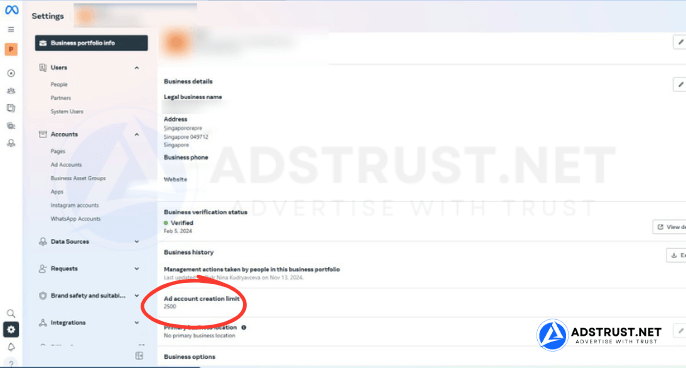
Many advertisers focus on BM numbers: BM5, BM10, BM50, BM2500.
These numbers only describe capacity, not resilience.
A BM with 50 ad account slots is not safer than a BM with 5.
In practice, larger BMs collapse faster when advertisers don’t understand how to pace growth.
Professionals select BM size based on intended usage, not future fantasies: testing, scaling, asset isolation, or long-term brand operations.
Capacity is useful only when paired with discipline.
Facebook Profile Accounts Explained : Global Guide for Ads & Growth
Verified Business Manager: The Most Misunderstood Feature
BM verification confirms business identity. It does not guarantee survival.
A verified BM with unstable behavior still gets restricted.
An unverified BM with clean, consistent structure can operate longer.
Verification amplifies trust signals — good or bad. It does not replace proper warm-up or risk management.
Advertisers who rely on verification alone often learn this lesson the hard way.
BM Warm-Up: Why This Phase Determines Everything
Warm-up is not about spending money slowly. It is about teaching Meta who you are.
A healthy warm-up phase includes: gradual asset attachment, stable user roles, predictable behavior patterns, and controlled activity growth.
Skipping warm-up creates one clear signal: this business is unstable.
In 2026, Meta reacts to that signal faster than ever.
How Experienced Advertisers Actually Use Business Managers
Professionals don’t treat BM as inventory. They treat it as infrastructure.
Instead of one overloaded BM, they use: separate BM for testing and scaling, verified BM for long-term brands, smaller BM for experiments, strict permission management.
The goal is not maximum capacity.
The goal is minimum blast radius when something goes wrong.
Buying Facebook Business Manager: What Actually Matters
When advertisers search for “buy Facebook Business Manager”, they are usually trying to recover from loss or prepare for scale.
The real value of a BM lies in: how it was created, how it was used, what assets touched it, and how clean its structure remains.
Cheap BM often becomes expensive later.
Infrastructure quality always costs less than rebuilding from zero.
Where AdsTrust Fits in the BM Ecosystem
AdsTrust.net operates as a global advertising infrastructure provider, not a shortcut seller.
Since 2018, AdsTrust has focused on: long-term asset usability, clean system design, and realistic expectations for advertisers.
We don’t sell BM as magic solutions.
We help advertisers build systems that can survive Meta’s trust model.
That difference matters.
Facebook Business Manager Is a Long-Term Commitment
Facebook Business Manager is not a tool you “use”. It is a system you maintain.
If you treat BM as disposable, Meta will agree. If you treat it as infrastructure, Meta will respond differently.
In modern Meta advertising, creatives win attention — but Business Manager Facebook decides survival.
Understanding BM is no longer optional. It is the cost of playing seriously.