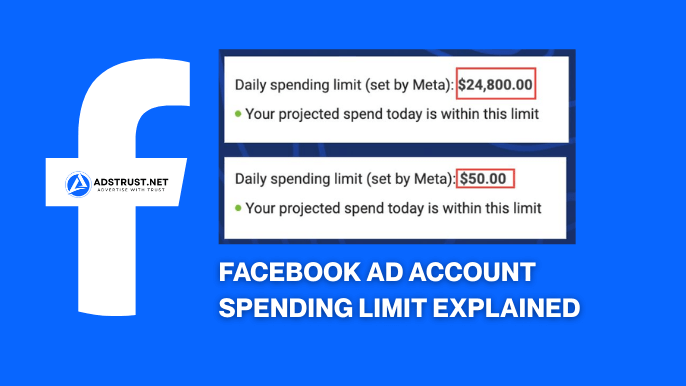
One of the most common frustrations in Facebook advertising is hitting a spending limit before campaigns have enough room to scale.
At that point, many advertisers start looking for tricks.
They change payment methods, duplicate campaigns, appeal limits, or create new accounts, hoping Facebook will suddenly allow more spend.
In most cases, those moves do not solve the real issue.
If you are trying to understand how to increase a Facebook ad account spending limit, the first thing to accept is that limits are not random.
They reflect how much trust Facebook currently assigns to the entire advertising environment around the account.
Why Facebook Ad Account Spending Limits Exist
Facebook uses spending limits as a risk-control mechanism.
New or unstable ad accounts are not treated the same way as accounts with long payment history and predictable behavior.
The platform wants proof that the advertiser can spend consistently, pay reliably, and operate without sudden structural changes.
That is why a spending limit is usually not about campaign quality alone.
It is about the platform’s confidence in the account, the Business Manager it sits in, the fanpage attached to it, and the payment pattern behind it.
For a broader explanation of how shared and controlled ad account environments work, this guide gives the full system view:
Facebook Ads Accounts Explained: Limits, Sharing & Scaling
What Actually Increases a Facebook Ad Account Spending Limit
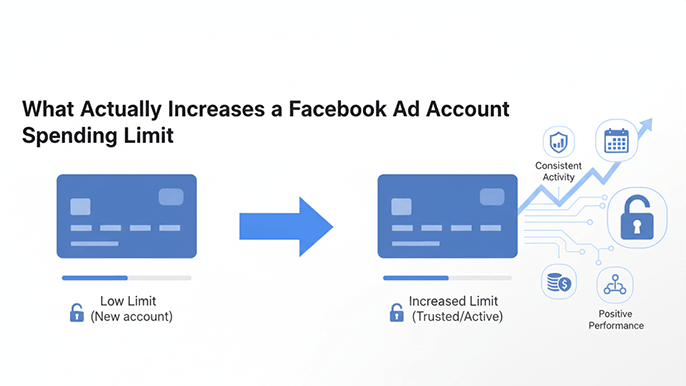
Facebook rarely increases limits because an advertiser wants it to.
Limits usually rise when the system sees a pattern it considers low risk.
That pattern is built through consistent billing, gradual budget growth, and stable operational behavior over time.
In other words, Facebook wants to see maturity before it allows more freedom.
Accounts that spend in a controlled way, complete payments successfully
And avoid frequent structural changes tend to progress more smoothly than accounts that try to accelerate too early.
This is why many advertisers feel stuck.
They focus on the number itself, while Facebook is still evaluating the quality of the environment around that number.
Why Good Campaign Performance Is Not Enough
A common misunderstanding is that profitable campaigns should automatically unlock more spending.
That is not how Facebook sees it.
Performance tells Facebook that ads may be working.
It does not automatically tell Facebook that the advertiser is stable, trustworthy, or ready for more exposure.
A campaign can convert well and still operate inside a weak infrastructure.
This is one reason why advertisers often see a strong return on ad spend while the account remains capped.
Commercial success and infrastructure trust are related, but they are not the same thing.
The Business Manager Behind the Account Matters More Than Most People Realize
Ad accounts do not operate on their own.
If the surrounding Business Manager is weak, newly created, or poorly structured, the ad account often inherits that weakness.
This affects how much spend Facebook is comfortable approving and how quickly internal trust grows.
Many advertisers try to increase ad account limits while ignoring the Business Manager layer completely.
That usually slows things down rather than speeding them up.
A full explanation of how Business Managers influence trust and capacity is here: Facebook Business Manager Explained : Types, Limits & Safe Usage Guide
Advertisers who are still in an early stage often operate inside smaller, controlled BM structures such as BM1 or BM350,
while more mature teams move into environments like BM5 or BM10 as their systems stabilize: Business Manager
Why Fanpages and Asset Stability Also Affect Spending Capacity
The ad account is only one layer.
Facebook also looks at the page running the ads, the profile or profiles managing access, and how often assets are replaced or moved.
If the fanpage looks unstable, new, or frequently restructured, that increases the system’s perceived risk.
This is why some advertisers feel they are doing everything right inside Ads Manager while still facing limitations.
The weakness may be elsewhere.
For a deeper look at how page age and verification influence ad environments, see: Buy Facebook Fanpage Explained: New vs Aged vs Verified Pages
In practice, many advertisers trying to stabilize a capped account prefer to work with more consistent page assets,
Especially when campaigns are moving beyond early testing: Facebook Fanpages
Why Creating New Accounts Often Makes the Problem Worse
When advertisers hit a limit, many of them respond by abandoning the account and creating another one.
On the surface, that feels logical. In reality, it often resets trust rather than increasing it.
A new account usually starts from a lower trust position, not a higher one.
If the same unstable Business Manager, the same weak page structure, or the same rushed behavior continues, the new account often runs into the same limit again.
This is one reason experienced advertisers stop asking.
“How do I escape this limit today?” and start asking, “What kind of environment is Facebook willing to trust over time?”
When a Controlled Ad Account Environment Makes More Sense
Some advertisers are not trying to increase a limit from zero. They are trying to avoid rebuilding fragile trust repeatedly.
In those cases, structured shared ad account environments can make more sense than forcing growth from a weak base.
A daily-limit shared account is often suitable for testing, warming, or controlled expansion, especially when the advertiser still needs predictable pacing:
Buy Facebook Ad Accounts Share ($250 Daily Limit)
When campaigns are already validated and the problem is no longer learning but scaling, a more mature environment becomes relevant.
That is where high-trust setups such as BM2500 shared accounts fit:
Buy Facebook Ad Accounts Share BM2500 (No Limit, Enterprise)
Both options sit inside the broader Facebook Ads Accounts category here: Facebook Ads Accounts
What Usually Slows Spending Limit Growth Down
The biggest problem is usually not a single mistake. It is a pattern.
Accounts tend to stay capped when advertisers keep changing too many variables too quickly.
New cards, new pages, new campaign structures, new access patterns, and sudden budget jumps all send the same message: instability.
Facebook responds conservatively to instability.
That is why patient advertisers often progress faster than aggressive ones.
They are not necessarily doing more. They are simply giving the system fewer reasons to hesitate.
How to Think About Spending Limits More Realistically
The most useful way to think about a spending limit is not as a wall, but as a diagnosis.
It tells you how much trust Facebook currently assigns to your setup.
That setup includes the ad account, the Business Manager, the fanpage, and the behavior connecting them.
If the limit is low, the question is not only “How do I increase it?” The more useful question is “What is the system still unconvinced about?”
That shift in thinking usually leads to better decisions.
Final Thoughts
Increasing a Facebook ad account spending limit is usually a result of trust accumulation, not a hack.
Advertisers who focus only on the number often stay stuck.
Advertisers who improve the surrounding structure — the BM, the page, the payment pattern, and the pace of growth — usually give Facebook enough reason to raise capacity over time.
The limit itself is not the real story. The environment behind it is.