In Meta infrastructure, that difference matters more than verification alone.
Many advertisers believe business verification is the point where a Business Manager becomes safe.
In practice, that is not how Meta works.
A Business Manager can be verified and still get restricted later.
That happens because verification confirms business identity, but it does not guarantee long-term trust.
Meta still watches how the BM is used, what assets are connected, how admins behave, and whether the account structure looks stable over time.
If you want to understand the bigger system behind this, the core foundation is in this guide to Facebook Business Manager.
This article focuses on one specific problem: why Facebook restricts Business Managers after verification, and what advertisers usually get wrong.
Verification is not the same as ongoing trust
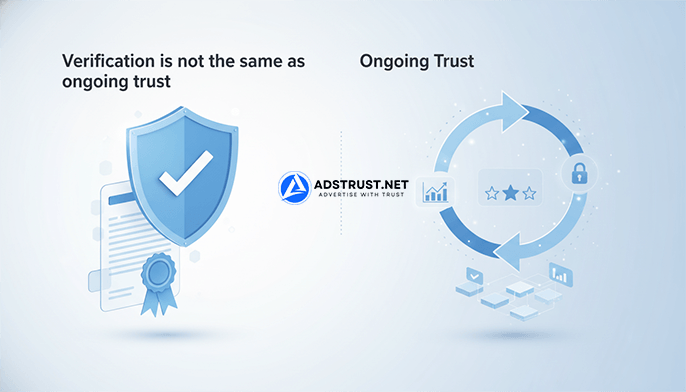
This is the main misunderstanding behind most post-verification restrictions.
When Meta verifies a business, it is checking whether the company, documents, and identity signals are acceptable.
That can unlock more trust potential, but it does not turn the Business Manager into a protected asset.
A verified BM still has to behave like a stable business environment.
That means Meta continues to judge what happens inside the structure after verification.
If the system sees unstable access, risky asset combinations, sudden scaling, or operational patterns that do not look natural, restriction can still happen.
This is why a verified Business Manager restricted status is not unusual.
Verification helps, but it does not erase weak behavior.
Why Facebook restricts Business Managers after verification

The short answer is simple: Meta does not only verify who you are. It also keeps evaluating how you operate.
A Business Manager often gets restricted after verification because the advertiser starts using it too aggressively.
Verification creates confidence, and that confidence sometimes turns into overuse.
Assets are added too quickly. Permissions become messy. Budget moves too fast.
Old risk gets imported into a new-looking structure.
From the advertiser’s side, it feels logical. From Meta’s side, it can look unstable.
That mismatch is where many verified BMs begin to fail.
A verified Business Manager Facebook can still carry old risk
Many people verify a Business Manager that is already structurally weak.
The BM may already contain mixed assets, unclear ownership, low-trust users, or ad accounts with a history of problems.
Verification does not clean up any of that. It only confirms business identity.
If the internal structure is messy before verification, it often remains messy after verification.
Fast changes after verification can create new risk
Another common pattern is sudden acceleration.
An advertiser gets verified and immediately starts adding people, pages, ad accounts, domains, and billing activity.
The BM goes from quiet to highly active in a very short period.
That change may feel like progress, but Meta often reads it as instability.
Verified infrastructure still needs a believable operating rhythm.
A strong identity with weak behavior creates contradiction
This is one of the less obvious reasons restrictions happen.
A verified business is expected to behave like a real and stable business.
So when Meta sees a strong identity signal attached to chaotic usage, the contradiction becomes clearer.
The account does not just look risky. It looks inconsistent.
And inconsistency is one of the fastest ways to lose trust.
The signals that usually trigger post-verification restrictions
In most cases, restrictions are not caused by one single action. They build from patterns.
Unstable admin activity
If admins are added and removed too often, roles change constantly, or access looks inconsistent across the BM, Meta may see the environment as poorly controlled.
A real business usually has stable access logic. A BM that behaves like a temporary shared workspace often looks less trustworthy.
Messy asset structure
A Business Manager should contain assets that belong together operationally.
When advertisers attach unrelated fanpages, risky ad accounts, unclear domains, or old assets from other setups, the BM becomes harder to trust.
Even if each asset looks manageable on its own, the total structure can still look wrong.
This is one reason contextual infrastructure matters.
A business that needs scale should build around the right BM type from the start, instead of forcing too much complexity into one environment.
That is also why the difference between Facebook Business Manager types and limits matters in real operations.
Aggressive spending behavior
Spending itself is not the problem. The pattern is.
If budgets jump too sharply, payment behavior becomes inconsistent.
Or account activity grows faster than the BM’s maturity suggests, Meta may interpret that as elevated risk.
This often overlaps with broader confusion around Facebook ad account spending limits, especially when advertisers assume “capacity” means “trust.”
No warm-up logic after verification
Some advertisers think warm-up ends once verification is approved.
Usually the opposite is true.
After verification, the BM still needs time to establish stable behavior.
If the first phase after approval is too fast or too noisy, the BM can look less trustworthy than before.
What advertisers usually misunderstand
The emotional reaction is often the same: “Why did Meta verify my business and then restrict it?”
The answer is that verification is only one checkpoint.
Meta’s trust model is ongoing. It does not make one permanent decision and stop there.
A BM can pass identity review and still fail later on behavior, structure, or risk signals.
That is why experienced advertisers do not treat verification as protection.
They treat it as a stronger starting point that still has to be managed correctly.
How to reduce the chance of restriction
There is no perfect guarantee, but most avoidable mistakes follow the same pattern.
Keep the BM clean.
Keep access stable.
Do not rush asset expansion.
Do not attach things that do not clearly belong there.
More importantly, do not let verification create false confidence.
A verified BM should be handled more carefully, not less carefully.
For advertisers who need a verified setup for serious operations, the real value of a verified Facebook Business Manager is not that it bypasses trust.
The value is that it gives you a stronger business-level foundation to operate correctly from the start.
Final Thoughts
If you want the simplest explanation, it is this:
Verification proves identity. It does not prove long-term account safety.
That is why Facebook restricts Business Managers after verification more often than many advertisers expect.
The BM may be real, but Meta is still judging whether the structure behaves like a stable business system.
The businesses that last are usually not the ones chasing shortcuts after approval.
They are the ones building a cleaner, slower, and more believable operating pattern over time.