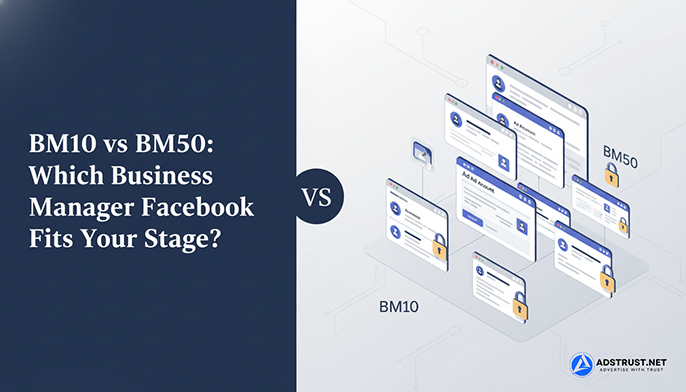
A lot of advertisers compare BM10 vs BM50 the wrong way.
The better question is not which BM sounds more powerful. The better question is which Facebook Business Manager fits your stage.
If you need the broader context first, the best foundation is the main guide to Facebook Business Manager
And the supporting article on Facebook Business Manager Explained.
This article focuses on one narrower comparison: when BM10 makes more sense
When BM50 makes more sense, and how to choose without creating unnecessary risk.
AdsTrust’s current BM pages already frame BM10 as structured, cost-efficient scaling and BM50 as a larger system for scalable operations and asset isolation,
Which makes this comparison especially relevant for buyers already inside the BM cluster.
Why BM10 vs BM50 is the wrong comparison if you only look at size
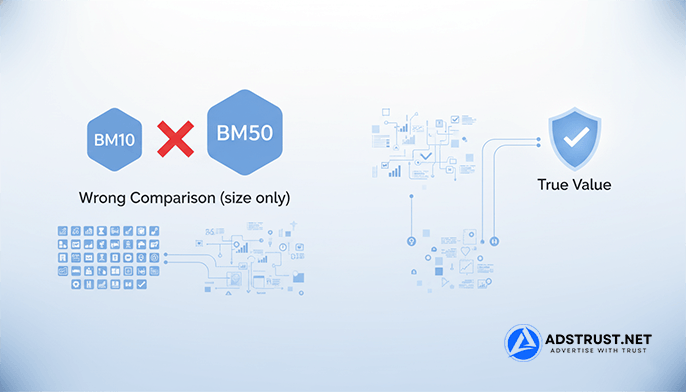
The number tells you capacity. It does not tell you fit.
AdsTrust’s BM hub explicitly warns against the “bigger is better” mindset and notes that BM numbers describe capacity, not resilience.
The hub also says larger BMs can collapse faster when advertisers do not understand pacing and intended usage.
That is the core mistake many buyers make when comparing BM10 vs BM50.
A Business Manager should be chosen based on how the business actually operates.
That includes campaign structure, asset control, team size, testing rhythm, growth speed, and how much organizational separation the business really needs.
So before comparing BM10 and BM50, it helps to stop thinking like a collector of BM capacity and start thinking like an operator building a clean Meta system.
What BM10 Facebook is actually for

BM10 is best understood as a structured scaling Business Manager.
AdsTrust describes BM10 as a 10-ad-account BM built for cost-efficient scaling, structured asset control, and long-term Meta advertising stability.
The supporting BM article also places BM10 in the “structured scaling” stage, where advertisers begin managing multiple campaigns, offers, or markets and need more segmentation without jumping straight into a very large system.
In practical terms, BM10 often fits businesses that are no longer in the earliest phase but still want a structure that remains manageable.
It gives more room than small entry-stage setups, but it does not automatically push the business into enterprise-style complexity.
That is why BM10 usually makes sense for advertisers who are growing, but still want a relatively clean and understandable operating environment.
What BM50 Facebook is actually for
BM50 is not just a bigger BM10.
AdsTrust positions BM50 as a 50-ad-account Business Manager designed for scalable Meta advertising, asset isolation
And long-term system stability, and describes it as ideal for agencies and advertisers managing multiple campaigns.
That wording matters because it points to a different type of use case.
BM50 is not only about having more room. It is about handling a more layered operating environment.
That usually means more campaigns, more segmentation, more assets, more parallel workflows, or a stronger need to isolate functions cleanly over time.
So when people compare BM10 vs BM50 as though they are just two sizes of the same tool, they miss the deeper point.
BM50 is often chosen because the business structure itself is more complex.
BM10 vs BM50: the real operating difference
The real difference is not the number of slots alone.
The real difference is how much system complexity the business can actually use well.
BM10 is often better for controlled growth
BM10 is usually the better fit when the business is actively growing but still wants discipline.
That could mean one brand with multiple campaigns, a team that is getting more structured,
Or an advertiser moving beyond early testing into a more organized scaling phase.
BM10 gives enough space to build with intention, but it still encourages clarity.
For many businesses, that is a strength.
A system that is easier to understand is often easier to keep healthy.
BM50 is often better for layered operations
BM50 makes more sense when the business already has enough moving parts to justify broader segmentation.
That can include multiple brands, multiple teams, more serious agency operations, more distinct campaign groups, or a stronger need for asset isolation.
AdsTrust’s own BM50 page highlights exactly those ideas: scalable operations, asset isolation, and long-term system stability.
But that does not mean BM50 is automatically safer. It only means BM50 is more appropriate when the business has a real reason to use that larger structure well.
Which Business Manager fits your stage?
This is the part most advertisers actually need.
If your business is still building process discipline, still clarifying team roles, or still learning how to keep assets organized, BM10 is often the cleaner choice.
It supports growth without pushing the business into unnecessary architectural sprawl.
If your business already has multiple parallel needs and a clear operational reason for more segmentation, BM50 may be the more natural fit.
The answer depends less on ambition and more on maturity.
That logic is already consistent across AdsTrust’s live content.
The BM explained page places BM10 and BM50 in a stage where segmentation becomes essential,
While the BM hub stresses that professionals choose BM size based on intended usage such as testing, scaling, asset isolation, or long-term brand operations.
The mistake many buyers make
The most common mistake is buying for fantasy instead of current reality.
An advertiser imagines future scale, then chooses a larger BM because it feels more advanced.
But future potential is not the same thing as present operational fit.
If the business does not yet have the structure to use a larger BM properly, the extra capacity often turns into clutter.
More room can become more mess.
That is why the question from the previous roadmap article still matters here: how many Business Managers should one business really have.
Choosing BM10 or BM50 is not just a product decision.
It is part of the wider architecture decision about how much structure the business can manage cleanly.
BM10 vs BM50 for agencies
Agencies often approach this choice differently from brands.
A smaller or more focused agency may do very well with BM10 if the goal is structured scaling without excessive complexity.
But an agency handling multiple client environments, layered workflows, or more complex asset separation may find BM50 more suitable.
That does not mean every agency needs BM50.
It means agencies should judge the choice based on operational shape, not status.
This also connects naturally with the earlier roadmap article on shared Facebook Business Manager vs owned BM
because some agencies need ownership and continuity while others are primarily solving for execution structure.
BM10 vs BM50 for brands and ecommerce teams
For brands, the decision is usually less about prestige and more about internal clarity.
If one brand is still operating inside a relatively unified environment, BM10 may be more than enough.
If the brand has grown into multiple markets, layered campaign systems, more internal teams
Or stronger isolation needs around assets and workflows, BM50 can make more sense.
The key is to avoid forcing enterprise-style complexity into a stage that still benefits more from simplicity.
A BM should help the business stay organized. It should not become a symbol of imagined scale.
The role of verified infrastructure
Sometimes the right question is not BM10 or BM50 first.
Sometimes the better question is whether the business needs a stronger owned foundation before worrying about size.
In that case, a verified Facebook Business Manager can be more relevant than jumping immediately into a larger-capacity structure.
AdsTrust is clear that its verified BM product does not promise instant scaling or special privileges beyond legitimate verification;
It is positioned as a verified foundation that the buyer builds on properly.
That matters because some businesses do not actually have a size problem yet. They have a structure problem.
A cleaner way to choose
Instead of asking which option is bigger, ask these quieter questions.
Does the business already have enough operational complexity to justify BM50?
Would BM10 create more clarity at the current stage?
Is the team disciplined enough to use a larger structure well?
Is the real need scale, isolation, ownership, or simply a cleaner foundation?
Those questions usually lead to better decisions than comparing raw BM numbers.
Final Thoughts
So, BM10 vs BM50: which Business Manager fits your stage?
Usually, BM10 fits businesses that are entering structured growth and need room without unnecessary complexity.
BM50 fits businesses that already have enough operational layers to benefit from broader segmentation, asset isolation, and a larger system.
The mistake is not choosing BM10 or BM50.
The mistake is choosing based on size alone.
If the Business Manager matches the stage of the business, it becomes easier to keep clean, easier to scale, and easier to manage over time.
And in Meta operations, the cleanest structure usually outperforms the most impressive-looking one.