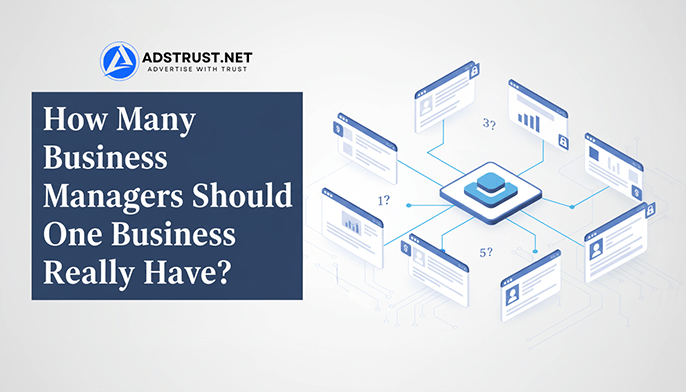
A lot of advertisers assume more Business Managers means more safety.
Others believe one Business Manager should hold everything forever.
In practice, both ideas can create problems.
The better question is whether the BM structure matches the way the business actually operates.
If it does not, assets become mixed, permissions get messy, testing interferes with stable operations, and the whole Meta setup becomes harder to manage over time.
If you need the broader foundation first, start with the main guide to Facebook Business Manager and the supporting article on Facebook Business Manager Explained.
This article focuses on one narrower decision: how many Business Managers one business should really have.
Why this question matters more than it seems?

A Business Manager is not just a technical shell around ad accounts.
It is the operating layer that holds together people, permissions, pages, pixels, domains, ad accounts, and business-level control.
That is why the wrong BM structure usually becomes a bigger problem later, not immediately.
At the beginning, one BM can seem manageable even when it is already carrying too many unrelated functions.
But as the business grows, the cracks become clearer. More teams need access. More assets are added.
Different campaign types begin to live in the same environment. Ownership logic becomes harder to explain.
At that point, the issue is no longer the ad account itself. The issue is architecture.
When one BM Facebook is enough

For many businesses, one Business Manager is enough.
That is usually true when the company is still relatively simple: one brand, one core team, one operating market, and one clear advertising purpose.
In that situation, forcing multiple structures too early can create unnecessary complexity.
A single BM often works well when the business has one coherent asset set and one practical operating system.
Everything belongs together, so splitting it apart too soon usually adds overhead instead of clarity.
This is also why earlier-stage options such as BM1 or BM10 make sense for some advertisers.
The point is not to collect more BMs than necessary. The point is to use a structure that matches the real stage of the business.
When one BM starts becoming a problem
One BM becomes a problem when it no longer reflects one clean operating environment.
That tends to happen gradually.
The business adds more markets, more people, more pages, more domains, more products, or more parallel campaign systems.
A setup that once looked tidy starts carrying too many different jobs at the same time.
The most common sign is not volume by itself. It is conflict.
Testing lives next to stable brand activity. Sensitive assets sit beside experimental work.
Teams that should be separated start sharing the same permission system.
Over time, the BM stops feeling like one coherent business environment and starts feeling like a storage room.
That is usually the point where the question of multiple Facebook Business Managers becomes legitimate.
When multiple Facebook Business Managers make sense
Multiple Facebook Business Managers make sense when the business has genuinely different environments that should stay structurally separate.
That could mean different brands, different entities, different teams, different markets, or different levels of risk.
The important point is that the separation should reflect reality. A second BM should exist for a clear business reason, not as emotional insurance.
Different brands or business entities
If a company operates separate brands with separate assets, teams, or ownership logic, separate BMs often make sense.
That keeps pages, domains, admin access, and operational history cleaner over time.
When assets truly belong to different businesses, forcing them into one BM usually creates confusion rather than efficiency.
Separation between long-term assets and higher-variance activity
Some advertisers need a cleaner divide between stable brand infrastructure and more experimental campaign activity.
That can be a valid reason to separate environments. The key is intentional structure.
A second BM should not become a dumping ground for random assets or reactive testing. It should have a clearly defined role.
Agency or client segmentation
Agencies often face this decision earlier than brands do.
A small agency may manage cleanly under one BM for a while.
But once client count, permissions, risk boundaries, and operational complexity grow, separate structures can become more sensible.
This connects directly with the earlier comparison between shared Facebook Business Manager vs owned BM
Because agencies often use different models depending on whether they need execution access or long-term control.
The hidden mistake: creating extra BMs without a real reason
This is where a lot of advertisers go wrong.
They create more Business Managers because it feels safer to have backups, duplicates, or scattered environments.
On the surface, that sounds practical. In reality, it often creates more confusion.
Assets become fragmented. Ownership becomes harder to track. Team access gets less clear.
Warm-up quality drops because attention is spread across too many structures.
More BMs do not automatically create a stronger system.
In many cases, they create more opportunities for bad management.
If a BM exists, it should have a job. If its purpose is vague, it usually becomes clutter.
A better way to decide
Instead of asking how many BMs sound ideal in theory, ask what role each BM would actually serve.
That question leads to much better decisions.
A business may only need one BM if all core assets and functions belong to the same operating system.
Another business may need two or three because it genuinely runs separate brands, separate entities, or separate operational layers.
The number matters less than the clarity.
That is also why some businesses are better served by building one stronger owned foundation
Such as a verified Facebook Business Manager, instead of scattering attention across too many weak structures.
How business stage changes the answer
The right number of BMs also depends on maturity.
A small advertiser with one offer and one team should not think like an enterprise operator.
On the other hand, a larger agency or multi-market brand should not force growing complexity into a structure that no longer fits.
AdsTrust’s BM ecosystem already reflects that lifecycle difference.
Smaller-stage infrastructure and larger-capacity infrastructure solve different problems.
A business that is still building operational discipline usually does not need to think the same way as one considering broader capacity options like BM2500 Facebook Business Manager.
The safest structure is usually the one that matches the current stage honestly.
What healthy businesses usually do
Most healthy businesses do not chase the highest number or the lowest number.
They aim for the cleanest number.
That usually means one BM when the business is still unified, and more than one only when the separation reflects a real business difference.
The goal is not expansion for its own sake. The goal is a structure that still makes sense six months later.
In practice, the cleanest BM architecture is usually the one that remains understandable as the company grows.
How to tell when you may need another BM
A business may be ready for another BM when the current one is trying to serve too many conflicting purposes.
That often shows up in subtle ways. Asset ownership becomes harder to explain.
Team permissions start getting messy.
Stable assets are affected by experimental work.
Internal roles stop mapping neatly to the BM.
People begin building workarounds because the structure no longer feels natural.
These are architecture signals.
They do not always mean “create another BM immediately.”
But they do mean the business should stop assuming the current setup is still the best long-term model.
Final Thoughts
So, how many Business Managers should one business really have?
Usually, as few as possible and as many as necessary.
One BM is often enough when the business is still clean, unified, and operating within one logical structure.
Multiple Facebook Business Managers make sense when the business truly has separate environments that should stay separate.
The mistake is not having one BM or several.
The mistake is building without a reason.
If the BM structure reflects the real shape of the business, it becomes easier to manage, easier to scale, and easier to keep stable over time.
And in Meta operations, that kind of structural clarity usually matters more than people expect.