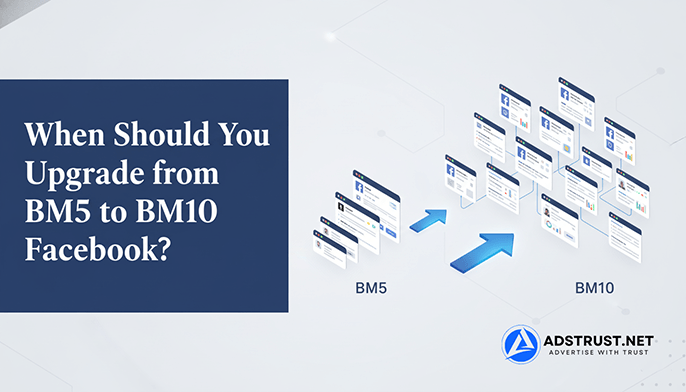
Many advertisers assume upgrading from BM5 to BM10 is the natural next step as soon as they want to scale.
In practice, that is not always true.
The right time to move from BM5 to BM10 depends less on ambition and more on structure.
If the business is still learning how to manage assets, permissions, and campaign separation cleanly, a larger BM may create more mess instead of more progress.
If you need the broader system first, start with the main guide to Facebook Business Manager and the companion article on Facebook Business Manager Explained.
This article focuses on a narrower decision: when should you upgrade from BM5 to BM10, and how to tell whether the move fits your actual stage.
AdsTrust currently positions BM5 as a structure for advertisers ready to scale with discipline
While BM10 is framed as the next step for more structured scaling and longer-term stability.
Why BM5 vs BM10 Facebook is really a stage question
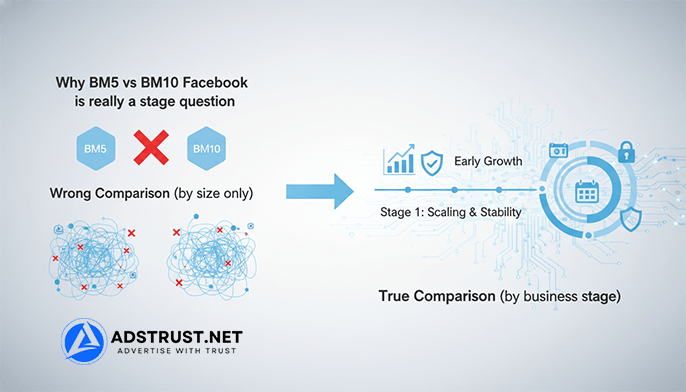
The biggest mistake in BM5 vs BM10 Facebook comparisons is treating both options like interchangeable sizes.
They are not. On AdsTrust, BM5 is described as a 5 ad account environment built for structured scaling, multi-campaign control, and stable Facebook advertising growth.
BM10 is positioned as a 10 ad account Business Manager built for cost-efficient scaling, structured asset control, and long-term Meta advertising stability.
That means the real difference is not only extra room. It is the level of operational structure the business is ready to use well.
So this is not just a capacity decision.
It is a maturity decision.
What BM5 Facebook is actually good at

BM5 is often the right structure when the business has moved beyond basic testing but still needs discipline more than breadth.
That usually means the advertiser already understands the basics, has proven some offers
And needs enough room to distribute activity across several ad accounts without turning the setup into a complicated system too early.
AdsTrust’s BM5 page explicitly says it is designed for advertisers who are ready to scale campaigns with structure, not for beginners who are still learning fundamentals.
In practical terms, BM5 often works well when one team is running one brand or one fairly unified operation.
It gives room to organize without encouraging unnecessary complexity.
That is a strong stage for many advertisers.
What changes when BM10 Facebook becomes relevant
BM10 becomes more relevant when the business starts needing cleaner segmentation, stronger asset control, and a more deliberate long-term system.
AdsTrust describes BM10 as built for cost-efficient scaling, structured asset control, and long-term Meta advertising stability.
The BM lifecycle article also places BM10 in the stage where advertisers are no longer simply warming up or doing early multi-campaign work,
But are building a more organized scaling environment.
That usually means the business has changed in one of these ways:
It is managing more parallel campaign groups.
It needs clearer separation between assets or functions.
It has more internal structure than BM5 comfortably supports.
It wants a system that feels less temporary and more deliberate.
The important point is that BM10 becomes useful when the business itself becomes more layered.
When you should not upgrade from BM5 to BM10 Facebook yet
Not every business that wants growth is ready for a larger BM.
If BM5 still feels clean, understandable, and sufficient for the actual way you operate, moving to BM10 too early can create the wrong kind of expansion.
More ad account capacity does not automatically improve trust, discipline, or decision-making.
AdsTrust’s BM hub is clear about this broader principle: BM numbers describe capacity, not resilience, and larger BMs can collapse faster when advertisers misunderstand pacing and intended usage.
That means you probably should not upgrade yet if the business still has weak operational habits.
If permissions are messy, assets are attached without a clear logic, or the current BM is already difficult to manage, adding more structure will not solve the real problem. It will usually amplify it.
Signs BM5 Facebook is no longer the right fit
A business is often ready to move past BM5 when the current structure starts carrying too many conflicting jobs.
That usually does not show up as one dramatic failure. It shows up as friction.
The same BM is trying to support too many campaign types.
Asset ownership is becoming harder to explain.
Teams are beginning to step on each other.
Workflows that once felt simple now feel cramped.
The system still functions, but it stops feeling clean.
That is usually the real signal.
The upgrade becomes sensible when BM5 is no longer helping the business stay organized.
Signs BM10 Facebook may be the better stage
BM10 tends to make more sense when the business is ready for structured growth rather than just more activity.
That could mean one brand with several mature campaign streams, an agency team with more deliberate asset separation,
Or an ecommerce business that now needs a more stable operating layer than BM5 comfortably provides.
This is also consistent with the stage logic already reflected across AdsTrust’s BM content,
Where early systems such as BM1 and BM5 serve simpler phases, while BM10 and beyond support more organized scaling.
The key is not that BM10 looks more advanced.
The key is that the business is finally able to use that added structure properly.
BM5 vs BM10 Facebook for agencies
For agencies, the decision usually comes down to workflow pressure.
A smaller or more focused agency may operate very well inside BM5 for a while, especially if the team is still relatively centralized.
But once client structures, access layers, asset boundaries, or campaign separation become more demanding, BM10 can become the cleaner fit.
This also connects naturally with the earlier roadmap article on shared Facebook Business Manager vs owned BM.
Some agencies are not only deciding between BM5 and BM10.
They are also deciding whether they need more ownership, more control, or simply a cleaner internal structure.
BM5 vs BM10 for brands and ecommerce teams
For brands, the decision is often about internal clarity.
If one brand still operates under a relatively unified structure, BM5 may continue to be enough.
But if the business now has more serious segmentation needs, more internal coordination,
Or a stronger need to organize long-term assets carefully, BM10 can become the healthier next step.
This is especially true when the business is trying to avoid the common trap covered in the earlier post on how many Business Managers one business should really have. Some businesses do not need more BMs.
They simply need the right BM for the stage they are already in.
The hidden mistake: upgrading for status
A lot of advertisers upgrade because a larger BM feels more professional.
That is a weak reason.
The safest upgrades usually happen because the business has outgrown the current structure operationally, not emotionally.
If the move is driven by imagined future scale rather than current system pressure,
The new BM often becomes underused, cluttered, or harder to manage than expected.
A better question is not “Can I upgrade?”
It is “Will this upgrade make the system cleaner?”
Sometimes the real need is not BM10
There are cases where the business thinks it needs a bigger BM, when the real need is a stronger foundation.
If ownership quality, verification, or long-term control is the issue
then a verified Facebook Business Manager may be more relevant than simply moving from BM5 to BM10.
AdsTrust’s verified BM page is careful not to promise instant scaling or special privileges
It presents verified BM as a legitimate verified foundation that the buyer still needs to build on properly.
That distinction matters.
Some businesses do not have a capacity problem.
They have an infrastructure problem.
A cleaner way to decide
If you are deciding between BM5 and BM10, ignore the urge to “level up” just because it sounds like progress.
Instead, look at the current shape of the business.
Is BM5 still clean and sufficient?
Is the team actually ready for more segmentation?
Are assets and permissions already managed well?
Would BM10 reduce friction, or simply give the business more room to be messy?
Those are the questions that usually lead to the right answer.
Final Thoughts
So, when should you upgrade from BM5 to BM10?
Usually when BM5 stops being a clean fit for the way the business actually operates.
BM5 works well when the business is scaling with discipline but still relatively unified.
BM10 makes more sense when the operation needs stronger segmentation, clearer asset control, and a more deliberate long-term structure.
The mistake is not staying on BM5 or moving to BM10.
The mistake is upgrading before the business is ready to use the larger structure well.
In Meta operations, the best BM is rarely the one with the bigger number. It is the one that matches the real stage of the business.