
A lot of advertisers judge a Facebook ad account on its own. That is usually a mistake.
Inside the Meta advertising system, the ad account is rarely evaluated in isolation.
The Facebook fanpage connected to the ads can shape how stable, believable, and trustworthy the whole setup looks over time.
That does not mean every page problem leads to an ad account problem.
It means the page layer often influences whether the account feels healthy or fragile.
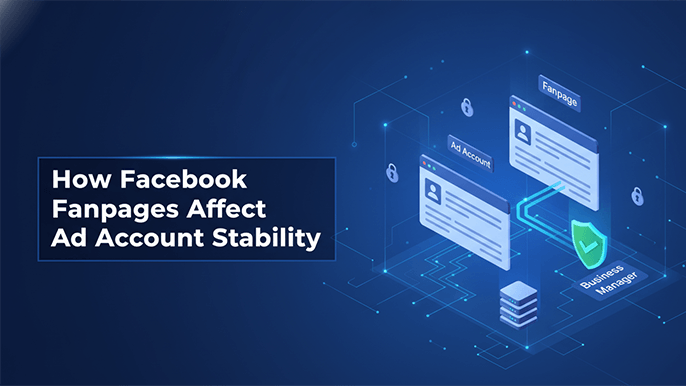
If you already understand the basics of account structure, this article explains how Facebook fanpages affect ad account stability
Why that relationship matters more than many advertisers realize, and what kind of page environment tends to support better long-term performance.
For broader context, it helps to read Facebook Ad Account vs Business Manager and Why Some Facebook Ad Accounts Stay Limited for Too Long.
A Facebook fanpage is part of the trust environment, not just a destination

Many advertisers treat the Facebook fanpage as a simple landing surface for ads.
Meta usually reads it as more than that.
A page carries signals about identity, history, consistency, and how believable the advertiser looks at the surface level.
When a Facebook ad account is attached to a weak page, the whole system can feel less mature.
When it is attached to a more stable page, the environment often looks calmer and more coherent.
That is one reason Facebook fanpage and ad account stability are closely connected.
The account runs the ads, but the page helps shape the trust environment surrounding those ads.
Meta does not evaluate Facebook accounts as isolated tools

This wider-system view matters.
AdsTrust’s Business Manager guide makes the same point from the infrastructure side:
Meta does not evaluate ad accounts in isolation, and the surrounding structure influences how risk is distributed over time.
That logic also applies at the page level. A Facebook ad account, Business Manager, and Facebook fanpage all contribute to the overall quality of the advertising environment.
That is why two advertisers can run similar campaigns and still get different outcomes.
The creative may be similar, but the surrounding signals are not.
A weak Facebook fanpage often makes the ad account look less stable
A weak page does not always mean a broken page.
Sometimes it simply means the page looks too thin, too new, too inconsistent, or too disconnected from the role it is supposed to serve.
In those cases, the Facebook ad account may struggle to build stronger trust because the page behind it does not reinforce credibility.
This is especially noticeable when advertisers expect a clean-looking account to perform like a mature asset while pairing it with a page that still feels underdeveloped.
The problem is not only page quality by itself.
The problem is mismatch.
History on a Facebook fanpage changes how the system feels
History matters because it affects how believable a page looks over time.
AdsTrust’s aged fanpage product positioning reflects exactly this idea.
The page describes aged Facebook fanpages as useful for stable advertising and long-term operations because they carry behavioral signals built gradually over time rather than compressed into a short window.
In practical terms, that kind of page history can create a calmer environment for the ad account connected to it.
That does not mean every aged page is automatically strong, or every new page is automatically weak.
It means historical behavior often shapes how much confidence the system can build around the page-account relationship.
New pages and mature pages support ad accounts differently
A new Facebook fanpage and an aged Facebook fanpage are not interchangeable in how they support a Facebook ad account.
A new page can still be useful, especially in earlier-stage testing or controlled launch situations.
But it usually needs cleaner pacing, more realistic expectations, and stronger surrounding structure.
An older or more established page may create more natural continuity for the advertising system, especially when the goal is long-term brand use rather than fast deployment.
This is also why product choice at the page layer matters.
AdsTrust describes Aged Facebook Fanpages as being built for stability and long-term trust, while page choice in general should match the business stage rather than imagined scale.
The page helps tell Meta what kind of advertiser this is
This is one of the quieter but more important roles of the Facebook fanpage.
The page helps tell a story.
It helps Meta understand whether the advertiser looks like a real brand, a temporary operator, a testing environment, or something in between.
A page with weak identity signals, little continuity, or poor coherence can make the whole advertising system feel less convincing.
A page with clearer history and more believable structure can help the system feel more stable.
That is why Facebook fanpage and ad account stability are not just loosely related. They are often part of the same story.
Thin page behavior can keep a Facebook ad account fragile
Some ad accounts remain unstable not because the campaigns are obviously bad, but because the page behind them never becomes convincing.
The page may look empty. It may have weak continuity. It may feel too abrupt in how it appears and begins running ads.
Or it may not support the kind of long-term trust signals the advertiser expects the account to build.
In that situation, the Facebook ad account keeps carrying the weight of a weaker page layer.
The account may still run.
It may even spend.
But stability often stays below what the advertiser expects.
Fanpage quality matters even more in testing-to-scaling transitions
This is where many advertisers start feeling the real difference.
A lighter page setup may be enough in early testing, especially when the goal is controlled learning rather than mature scale.
But when the business wants to move toward stronger, more stable advertising, the page often becomes more important.
Weak page signals that were tolerable during testing can start holding the account back once the advertiser expects more continuity.
That is one reason the roadmap article Facebook Ads Accounts Explained: Limits, Sharing & Scaling matters in the wider cluster.
The account’s next stage is not only about spend. It is also about whether the surrounding assets look ready for that stage.
A stronger page does not magically fix a weak Facebook ad account
It is important not to overstate the page layer.
A better Facebook fanpage can support the environment, but it does not erase weak account history, poor payment behavior, or bad operating discipline.
If the Facebook ad account itself has deeper issues, the page alone will not rescue it.
This is similar to the logic behind the article Can a Strong BM Fix a Weak Ad Account?
Better infrastructure can help, but it does not automatically rewrite the trust profile of a weak asset.
The same is true here.
A stronger fanpage can improve the system around the account. It cannot replace good account behavior.
When the problem is really page-account mismatch
Sometimes neither the page nor the account is terrible on its own.
The real issue is that they do not belong together naturally.
A more mature page may be paired with an account that still behaves like a testing asset.
Or a fragile new page may be expected to support long-term scaling immediately. In both cases, the system feels inconsistent.
Meta tends to evaluate these relationships behaviorally.
If the page-account pairing does not make sense, stability often suffers even when no single asset looks catastrophic by itself.
That is why serious advertisers try to match asset maturity more carefully.
What stable Facebook page support usually looks like
A healthier Facebook fanpage environment usually feels believable.
The page has a clear identity. Its history makes sense. It does not look rushed or artificially assembled.
Its role aligns with the stage of the Facebook ad account connected to it. The whole setup tells one coherent story.
That does not guarantee perfect outcomes.
But it usually creates a more stable base than a page layer that looks thin, abrupt, or disconnected from the advertising purpose.
What this means for advertisers choosing page assets
Advertisers should not choose a page only by convenience.
They should ask what role the page is meant to play in the wider Meta advertising system.
Is it for early testing? Is it for long-term brand use? Is it expected to support a more stable scaling phase? The answer changes what kind of page makes sense.
That is also why page selection should connect with account selection.
A Facebook ad accounts share $250 daily limit setup is explicitly positioned by AdsTrust for testing, warming, and controlled growth rather than maximum volume.
Pairing early-stage account behavior with an unrealistic page expectation usually creates friction.
Final Thoughts
So, how do Facebook fanpages affect ad account stability?
Usually by shaping the trust environment around the account.
The Facebook ad account may run the campaigns, but the page helps determine how believable, mature, and coherent the whole system feels inside Meta.
A stronger page does not guarantee a stronger account. But a weak or mismatched page often makes it harder for the account to become stable over time.
That is why serious advertisers do not only ask whether the account is good.
They also ask whether the page behind it supports the kind of stability they want to build.
Need trusted pages for stable delivery? See our Facebook Fanpages: new, aged, and Meta-verified.