A lot of advertisers try to solve a weak Facebook ad account by changing the structure around it.
The most common version of that is simple: move the account into a stronger Meta Business Manager and hope stability improves.
Sometimes that helps a little. Often, it does not fix the real problem.
That is because a Business Manager and a Facebook ad account do not do the same job inside the Meta advertising system.
A stronger BM can improve ownership structure, asset control, and operating clarity. But a weak ad account may still carry weak trust signals of its own.
If you need the broader system first, start with Facebook Ad Account vs Business Manager and How Business Manager Controls Ad Accounts.
This article focuses on a narrower question: can a strong Business Manager fix a weak Facebook ad account, or are advertisers expecting infrastructure to repair something deeper?
A Meta Business Manager and a Facebook ad account solve different problems
This is the first distinction many advertisers miss.
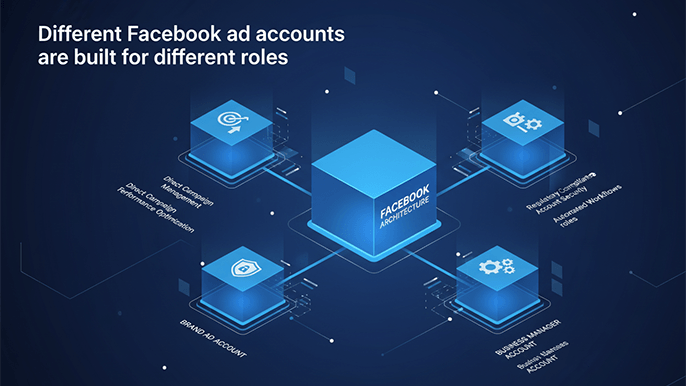
A Meta Business Manager is the structure that holds ownership, permissions, pages, pixels, domains, and ad accounts together.
A Facebook ad account is the asset that actually runs the advertising activity. One is infrastructure. The other is the operating unit for ads.
That means strength at the BM level does not automatically transfer into strength at the ad account level.
A cleaner Business Manager can make the overall system look more organized. It can reduce structural mess.
It can support better governance. But if the Facebook ad account itself has weak history, unstable behavior, poor payment patterns, or testing-level maturity, those issues do not disappear just because the account sits inside a better BM.
What a strong Business Manager Facebook can improve?

It is still important not to understate the value of a strong Meta Business Manager.
A better BM can improve the environment around the Facebook ad account in meaningful ways.
It can create clearer ownership, cleaner asset relationships, more stable admin control, and a more believable operational structure.
When the surrounding system is weak, that kind of improvement matters.
This is especially relevant if the ad account has been operating inside a messy setup.
A more coherent BM can remove noise that may have been making the whole advertising environment look less trustworthy.
That is why some advertisers do notice improvement after moving into a better Business Manager.
The environment becomes stronger.
But that is not the same as saying the ad account itself has been fixed.
What a strong BM Facebook cannot repair?
A stronger Business Manager cannot erase the direct signals attached to a weak Facebook ad account.
It cannot rewrite poor payment behavior.
It cannot instantly mature an account that still behaves like a testing asset.
It cannot remove weak trust history that the account has already built.
It cannot force Meta to forget how that specific account has behaved over time.
This is the part advertisers often resist.
They want infrastructure to work like a reset button. In practice, it usually works more like a frame.
It can support better behavior going forward, but it does not automatically cancel the account’s earlier weaknesses.
That is why a strong BM and weak ad account can still remain a weak combination.
When the Business Manager Facebook is the real problem
There are cases where the Meta Business Manager is actually the bigger issue.
If the BM is disorganized, unstable, overloaded, or poorly controlled, then even a decent Facebook ad account may struggle inside that environment.
In that kind of setup, upgrading the BM layer can make a real difference because the account was being held back by weak infrastructure rather than by its own behavior.
This connects naturally with Why Facebook Business Manager Gets Disabled and Why Bigger BM Facebook Is Not Always Better.
A stronger BM is not simply a larger one. It is one that is cleaner, better matched to the business stage, and managed with more discipline.
If the environment improves, the ad account may perform in a more stable way.
But that is different from saying the account itself has been repaired.
When the Facebook ad account is the real problem
This is the more uncomfortable situation.
The advertiser wants the BM to solve something that really belongs to the account.
The Facebook ad account may have limited trust, stop-start behavior, weak payment signals, inconsistent campaign rhythm, or a role that still looks temporary.
In that case, changing the surrounding BM may make the system look better, but the core weakness remains where it started.
This overlaps directly with Why Some Facebook Ad Accounts Stay Limited for Too Long.
A limited account often stays limited because trust has not grown at the account level, even if the business keeps improving other layers around it.
That is why you have to diagnose the right layer before trying to fix it.
A stronger BM Facebook can support recovery, but it cannot fake maturity
This is usually the most accurate middle ground. A stronger Meta Business Manager can support a healthier future for a Facebook ad account.
It can make the system cleaner, reduce environmental instability, and create conditions that help the account behave more credibly over time.
If the account is not deeply damaged, that support can matter. But support is not the same as substitution.
A strong BM cannot pretend that a weak ad account is already mature.
It cannot create trust faster than the account’s behavior justifies. Meta still watches the account itself.
So the BM can help create better conditions. It cannot manufacture history.
The role of page Facebook quality in this equation
The BM is not the only surrounding layer that matters.
As discussed in How Facebook Fanpages Affect Ad Account Stability
The Facebook fanpage connected to the ads also shapes how believable the system feels.
If the page layer is weak, moving the account into a stronger BM may still leave the overall setup fragile.
That is why serious advertisers do not ask whether the BM is strong in isolation.
They ask whether the whole environment makes sense together.
A strong BM, weak page, and weak ad account rarely become a stable combination just because one layer improved.
Shared structure vs owned structure changes the answer
Sometimes the question is not only about strength.
It is about control.
A Facebook ad account sitting inside a better-owned system may gain from stronger discipline and cleaner operational logic.
But that still depends on the account’s own signals.
This is why Shared Ad Accounts vs Owned Ad Accounts matters here.
Shared structure can be useful for access and execution, while owned structure may be better for continuity and system control.
The key point is that ownership quality can improve the environment, but it does not guarantee account-level recovery.
A weak account still has to become stronger through behavior.
Stronger infrastructure matters most when the business is ready to use it well
A lot of advertisers buy stronger infrastructure before they are ready to operate it well. That is a mistake.
A stronger Meta Business Manager can absolutely be valuable, especially when the business is moving toward cleaner, more deliberate operations.
A verified Facebook Business Manager may give the business a more formal and stable foundation.
A larger-capacity structure may support more organized segmentation when the business has actually reached that stage.
But if the business is still making weak decisions at the account level, stronger infrastructure usually just gives those weak decisions a cleaner container.
That is not the same as real improvement.
The better question is where the weakness actually lives
This is the question that saves time.
Instead of asking whether a strong Business Manager can fix a weak Facebook ad account, ask where the weakness truly sits.
Is the problem ownership and asset control? Is the problem weak page support? Is the problem payment behavior?
Is the problem that the ad account still behaves like a testing asset? Is the problem that the wider Meta structure does not match the business stage?
Once that becomes clear, the right solution is usually much easier to see.
What experienced operators usually do
Experienced operators rarely expect one asset layer to rescue another completely.
They improve the environment where it is weak, but they do not confuse environmental improvement with account recovery.
If the BM is weak, they strengthen the BM. If the page is weak, they improve the page layer.
If the Facebook ad account itself is weak, they treat that as an account-level issue rather than hiding it under better infrastructure.
That is a calmer way to build. And it usually produces better long-term stability.
Final Thoughts
So, can a strong Business Manager fix a weak Facebook ad account? Sometimes it can help. Usually it cannot fully fix the problem by itself.
A stronger Meta Business Manager can improve the environment, reduce structural noise, and support better future behavior.
But if the Facebook ad account has weak trust signals of its own, the BM cannot erase them. Infrastructure can support recovery. It cannot replace it.
That is why the smartest move is not to ask whether the BM is strong enough to save the account.
It is to identify which layer is actually weak, then fix that layer honestly.
Need stable, verified ad accounts? Browse our Facebook ad accounts ($50 to No-Limit), tested before delivery with a replacement warranty.