
A disabled Facebook Business Manager rarely feels fair when it happens.
From the advertiser’s side, the BM may still look usable. Assets are connected. Ad accounts are active. The system does not seem obviously broken.
Then one day, the Facebook Business Manager disabled status appears, and the whole structure becomes difficult to use or trust again.
In many cases, that outcome was building long before it became visible. Meta does not treat Facebook Business Manager like a simple admin panel anymore.
It treats BM as part of the trust structure behind the wider Meta advertising system.
That is why a BM is usually not disabled because of one random moment. It is disabled because too many weak signals have been building inside the structure over time.
If you need the broader foundation first, start with Facebook Business Manager (BM): Complete Guide to Types, Limits & Safe Usage
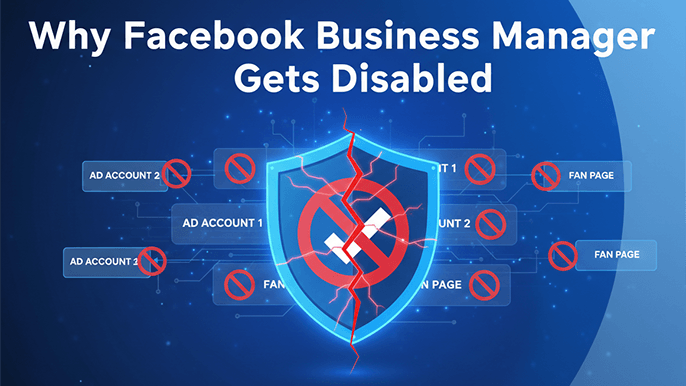
This article focuses on the narrower question: why Facebook Business Manager gets disabled, and what usually causes Meta to stop trusting the BM environment.
A Facebook Business Manager usually gets disabled after trust has already weakened

One of the biggest mistakes advertisers make is assuming BM disablement is sudden.
Usually, it is not. A Facebook Business Manager often gets disabled after Meta has already seen enough instability in the structure.
That instability may build slowly through access behavior, weak asset grouping, poor operational rhythm, or a BM that never develops a clear business identity.
By the time the disablement becomes visible, Meta may already have been losing confidence for quite a while.
That is why a disabled BM should usually be read as a signal of accumulated weakness, not just a one-time event.
Unstable admin access is one of the clearest reasons Meta loses trust

A real business environment usually looks controlled. When a Facebook Business Manager does not look controlled, Meta has a reason to doubt it.
That often happens when too many people are added too quickly, roles change repeatedly, admin access feels messy, or the BM behaves more like a temporary shared workspace than a stable operating system.
Even if nothing dramatic happens in one day, unstable access patterns can make the entire BM look less trustworthy over time.
A BM is not only judged by what assets it holds. It is also judged by how people move through it.
Weak asset grouping makes a Facebook Business Manager harder to believe
A Meta Business Manager should make structural sense.
That means the ad accounts, pages, domains, and other assets inside it should belong together in a believable way.
When unrelated or weak assets are pushed into one BM just because there is room, the whole structure becomes harder to trust.
This is one of the most common reasons a Facebook Business Manager starts drifting toward disablement.
The problem is not always one bad asset. The problem is often the combination.
A BM that mixes too many different histories, purposes, or risk profiles begins to look structurally weak.
That is also why the wider logic in the Facebook Business Manager guide matters. A BM is not a storage box. It is an ownership and control layer.
Fast structural changes often send the wrong signals
Many advertisers damage a BM when they move too fast after setup.
They add assets aggressively. They attach more accounts than the current structure can support cleanly.
They keep changing roles, rebuilding the layout, and expanding complexity before the BM has developed stable behavior.
From the advertiser’s side, this can feel like growth. From Meta’s side, it can look like instability.
A Facebook Business Manager that changes too much, too quickly often fails to build a believable operating rhythm.
And when that rhythm never stabilizes, disablement becomes much more likely.
Verification does not stop a Facebook Business Manager from being disabled
This is another major misunderstanding. A lot of advertisers assume business verification gives a BM long-term protection. It does not.
A verified Facebook Business Manager may have a stronger identity layer, but Meta still evaluates how the BM behaves after verification.
If the structure remains messy, access remains unstable, or asset logic remains weak, the BM can still be disabled.
That is why the related article Why Facebook Restricts Business Managers After Verification matters here, and why a verified Facebook Business Manager should be understood as a stronger foundation, not a shortcut.
Verification can support trust. It does not replace operational discipline.
Weak behavior inside connected ad accounts can hurt the BM too
A Facebook Business Manager does not operate separately from the assets inside it.
If the connected Facebook ad accounts show weak payment behavior, unstable pacing, fragile trust signals, or repeated structural problems, the BM may absorb part of that weakness.
Meta does not only judge the shell. It also watches what kind of behavior the shell is holding.
This is one reason the relationship between BM and ad accounts matters so much.
If you have not already read How Business Manager Controls Ad Accounts, that link in the system becomes much clearer.
A weak ad account environment can slowly make the BM itself look less reliable.
Some Business Managers get disabled because they were never warmed up properly
A BM can look fine at creation and still fail later because the early behavior was wrong.
Warm-up is not just about waiting. It is about teaching Meta what kind of structure this is.
If the BM starts with erratic user behavior, rushed asset additions, or no clear operating pattern, it may never develop the trust profile needed for stability.
That is why the later cluster article How to Warm Up a Verified Business Manager Safely is so important.
A BM that skips proper warm-up often begins with noise, and that noise can stay attached to the structure longer than advertisers expect.
Choosing the wrong BM stage can create avoidable disablement risk
Not every Facebook Business Manager fits every business stage. This is where many advertisers create problems for themselves.
They choose a BM because the number sounds bigger, more advanced, or more future-proof.
But a larger or more complex BM does not automatically make the system stronger. Sometimes it only creates more room for weak management.
That is why BM stage matters. A business that still needs simplicity may be better served by BM1, BM5, or BM10 instead of forcing complexity too early.
A structure that does not match the real stage of the business often becomes harder to control, and harder for Meta to trust.
A disabled Facebook Business Manager usually reveals deeper structural problems
When a Facebook Business Manager gets disabled, the disablement is often showing you something larger than the visible restriction.
It may reveal that the BM never had clear ownership logic. It may reveal unstable admin patterns.
It may reveal poor asset discipline. It may reveal that the business treated BM like inventory instead of infrastructure.
That is why disablement should not only trigger recovery thinking. It should trigger diagnosis.
What advertisers should review first after a BM gets disabled
The most useful response is usually not emotional. It is structural.
Look first at who had access, how often permissions changed, what assets were attached, whether the BM had one clear role
Whether verification created false confidence, and whether the wider environment actually looked like one believable business system.
Those answers usually tell you more than the disablement notice itself.
Closing view
So, why does Facebook Business Manager get disabled? Usually because Meta no longer sees it as a stable business environment.
A Facebook Business Manager disabled status is often the result of accumulated structural weakness:
Unstable access, poor asset grouping, rushed change, weak connected account behavior, or a BM that never developed a believable operating identity.
That is why the best long-term solution is not just to react after disablement. It is to build the BM in a way that Meta can keep trusting before disablement ever arrives.