
A lot of advertisers think a verified Facebook Business Manager should be safe.
That assumption causes real damage. Once a BM has passed business verification, many operators relax too early.
They add assets faster, move access around more casually, or assume Meta now sees the structure as permanently trusted.
Then the BM gets restricted anyway, and the whole situation feels unfair.
In practice, this is one of the most predictable mistakes in Meta Business Manager operations. AdsTrust’s verified BM product page is careful about this.
It says a verified BM starts from a stronger position because the business entity has already been verified, but it does not promise automatic safety, guaranteed limits, or permanent protection from future problems.
The product is positioned as a stronger base, not a shortcut.
If you need the broader foundation first, start with the main Facebook Business Manager guide and Facebook Business Manager Explained.
This article answers the narrower question: why verified Facebook Business Managers still get restricted, and what Meta is usually seeing when that happens.
Verification strengthens identity, but it does not replace operational trust

This is the core misunderstanding. Verification tells Meta that the business identity behind the BM has been confirmed.
AdsTrust’s verified BM page says that includes details such as business name, phone number, website domain, and business address, and that a verified BM starts from a different trust position than a regular new BM.
But verification is only one layer. A Facebook Business Manager still has to behave like a stable business environment after verification.
Meta continues evaluating what happens inside the BM: how assets are added, how admin access changes, how connected ad accounts behave, and whether the structure still looks coherent over time.
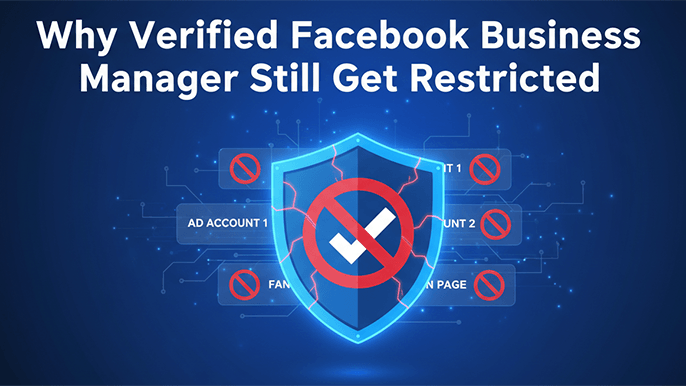
That is why a verified Facebook Business Manager restricted status is not a contradiction.
It is usually a signal that identity was strong, but behavior became weak.
A verified BM often gets restricted after the operator becomes less disciplined

This is one of the most common post-verification patterns. The BM is verified, so the advertiser starts treating it like a protected zone. Assets are attached faster.
Permissions become looser. Growth happens with less caution. The operator stops thinking about pacing because the BM now feels “strong enough.”
That is usually where trust starts to erode.
AdsTrust’s BM content consistently frames Business Manager as infrastructure that Meta evaluates behaviorally over time, not as a one-time setup milestone.
Their BM hub warns that structural instability, inconsistent access, risky asset combinations, and lack of a clear behavioral identity often sit behind BM restrictions.
Verification may improve the starting position. It does not make poor habits safe.
Unstable access patterns still damage a verified Facebook Business Manager
A verified BM still has to look like a real operating environment.
If admin roles change too often, too many people move through the system, or access looks improvised, the BM starts losing credibility.
Meta does not stop caring about access discipline after verification.
If anything, a verified structure with messy access can look even more contradictory, because the identity layer is strong while the behavior layer is chaotic.
This is one reason many verified BMs get restricted after what feels like “normal growth.” The growth may not look normal from Meta’s side.
It may look uncontrolled.
Risky asset combinations still make the BM harder to trust
A verified Facebook Business Manager can still become structurally weak if the assets inside it do not belong together clearly.
That may include ad accounts with mixed histories, pages added without a clear role, domain relationships that do not feel consistent, or a BM that starts collecting unrelated operational pieces simply because the operator assumes the verified shell can carry them safely.
AdsTrust’s main BM guide says Meta evaluates how assets are grouped and how risk is distributed over time, not just whether one asset is active.
A verified BM with poor asset logic can still lose trust because the system no longer looks coherent.
A strong identity layer cannot rescue a weak asset structure forever.
Verification can create false confidence around scaling
This is another pattern worth stating clearly.
A verified BM is often treated as permission to accelerate. But AdsTrust’s verified BM product page does not position verification that way.
It says advertisers usually buy a verified BM and then create ad accounts themselves so they can control account structure, payment methods, spending behavior, and warm-up pace.
That wording matters because it implies discipline is still required after verification, not removed by it.
So when a verified BM gets restricted after faster growth, the problem is often not verification itself. The problem is the confidence that followed it.
Weak behavior in connected ad accounts can still pull the BM down
A Facebook Business Manager does not operate separately from the assets inside it.
AdsTrust’s BM explained guide says Meta assigns trust, limitations, and permissions at the BM level based on factors including account behavior, payment history, business verification status, and long-term usage patterns.
That means connected Facebook ad accounts still matter after verification.
Weak account behavior, unstable payment rhythm, or inconsistent operating patterns can still damage how the BM is read over time.
This is why the relationship between BM and ad accounts matters so much.
If you have not already read How Business Manager Controls Ad Accounts, that system-level connection becomes much clearer.
A verified BM is stronger than a weak BM. It is not stronger than its own accumulated behavior forever.
A verified BM can still be the wrong fit for the business stage
This is one of the quieter causes of restriction.
Some businesses move into a verified BM before they have the discipline to operate it properly.
Others treat verification as a substitute for stage fit. But AdsTrust’s live BM ecosystem clearly separates BM types by stage and use case
From smaller controlled structures like BM1 and BM350 through BM5, BM10, BM50, and BM2500.
Their BM explained guide also frames verified BM as a trust-first infrastructure stage, distinct from capacity-first stages like BM2500 enterprise operations.
That matters because a verified BM is not automatically the right answer for every operator.
It is the right answer only when the business is ready to use that kind of foundation well.
Warm-up still matters after verification
A lot of advertisers think verification ends the need for caution. It usually does the opposite.
AdsTrust’s verified BM page says advertisers often buy a verified BM without ad accounts so they can create them themselves and control warm-up pace carefully.
That is a strong clue about intended usage: verification gives you a better base, but the next layers still need to be built gradually.
So if a verified BM gets restricted later, one of the first things to review is whether the BM was ever introduced to Meta in a believable way after verification.
A stronger base still needs a stable rhythm.
The restriction usually reveals a mismatch between identity and behavior
This is the most useful diagnostic view.
When a verified BM gets restricted, the problem is often not that verification failed. The problem is that the BM started telling two different stories at once.
The identity story says: real business, verified entity, stronger foundation.
The behavioral story says: unstable access, weak asset grouping, rushed growth, inconsistent operating discipline. Meta can tolerate a lot.
But it is usually less comfortable when those two stories stop matching.
That is why a verified BM restriction often feels especially confusing to the advertiser.
The business sees the identity layer. Meta is still reading the behavior layer.
What advertisers should review first when a verified BM gets restricted
Do not start by assuming Meta made no sense.
Start by reviewing the structure honestly. Look at how access changed after verification.
Look at what assets were attached and why. Look at whether ad accounts inside the BM behaved cleanly.
Look at whether verification created overconfidence in growth decisions.
Look at whether the BM still felt like one coherent operating system. These are the places where the answer usually appears.
Closing view
So, why do verified Facebook Business Managers still get restricted?
Usually because verification improved identity, but did not protect the BM from weak behavior afterward.
A verified Facebook Business Manager restricted status is often the result of unstable access, poor asset grouping, rushed scaling, weak connected ad account behavior, or a mismatch between the business identity Meta verified and the structure the operator built on top of it.
AdsTrust’s own verified BM content makes this clear: verification provides a stronger starting point, not a free pass.
That is why the safest way to use a verified BM is not to trust the badge too much.
It is to keep building in a way the system can continue believing.