
A lot of advertisers think the Facebook ad account is the real center of the system.
In practice, that is only partly true. The Facebook Business Manager often controls more than advertisers realize.
It shapes who can access the ad account, what assets can be connected around it, how the account fits into the wider Meta advertising structure, and how risk is grouped over time.
That is why two ad accounts that look similar on the surface can behave very differently depending on the BM sitting above them.
If you already understand the basics of BM structure, this article explains how Business Manager controls ad accounts
What that control really means inside Meta, and where advertisers usually misunderstand the relationship between a Facebook Business Manager and the ad accounts inside it.
For broader context, it helps to read the main Facebook Business Manager guide and Facebook Business Manager Explained.
AdsTrust’s BM guides describe Business Manager as the ownership and control layer of the Meta system, not just a simple admin dashboard.
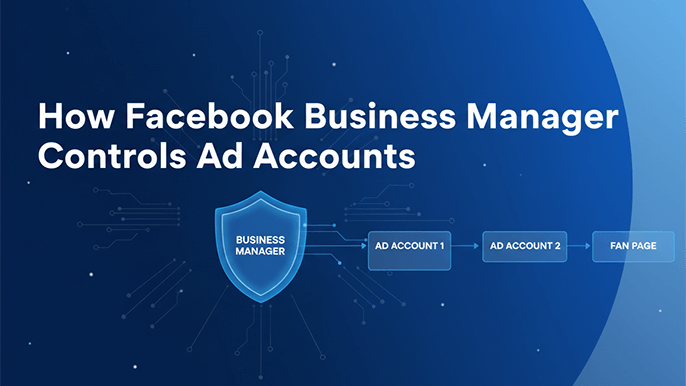
A Facebook Business Manager is the control layer above the ad account

This is the first distinction many advertisers miss. A Facebook ad account runs the campaigns, but the Facebook Business Manager decides the environment the account lives inside.
AdsTrust’s BM guide says BM is the ownership and control layer of the Meta advertising system, deciding who owns assets, who can operate them, and how risk is distributed.
That means BM does not replace the ad account, but it absolutely shapes how the ad account is governed.
That is why ad account issues are often not only ad account issues. Sometimes the real pressure is coming from the BM structure above it.
Facebook Business Manager controls who can touch the ad accounts

The most visible layer of control is access.
A Facebook Business Manager decides which people, partners, or teams can be attached to the ad account, what roles they hold, and how stable that access pattern looks over time.
Meta does not only care whether an ad account exists. It also cares whether the control around that account looks like a real business environment.
If access becomes messy, the ad account usually becomes harder to trust as part of the wider system.
AdsTrust’s BM guide explicitly lists inconsistent user access patterns as a core source of BM-level risk, and those patterns naturally affect the ad accounts inside that BM as well.
This is why Facebook Business Manager and ad account control cannot be separated cleanly. The BM controls the human layer around the account.
Facebook Business Manager controls what assets sit next to the ad account
An ad account does not live alone. Inside a Meta Business Manager, the account sits beside pages, domains, pixels, and other advertising assets.
AdsTrust’s BM content emphasizes that Meta evaluates how these assets are grouped and how risk is distributed across them over time.
If the grouping makes sense, the whole structure looks more believable. If the grouping looks weak, unrelated, or chaotic, the ad account is forced to live inside that weaker context.
That matters because Meta does not only read account behavior in isolation. It reads whether the account belongs in the system around it.
Facebook Business Manager controls how risk is shared across the structure
This is one of the less obvious but more important layers of BM control.
AdsTrust’s BM guide says Meta evaluates Business Managers as behavioral entities over time and tracks trust, limitations, and permissions at the BM level based on factors like account behavior, payment history, verification status, and long-term usage patterns.
That means the BM is not just holding ad accounts. It is also accumulating meaning from what happens inside them.
So when one part of the system becomes unstable, the effect may not stay isolated. A weakly managed ad account can damage how the BM is read.
A weak BM can make the accounts inside it more fragile. That is how risk begins to spread.
Facebook Business Manager controls the stage the ad account is expected to operate in
This is where many advertisers make poor decisions. Different Business Managers are built for different operating stages.
AdsTrust’s live BM category and product pages clearly separate BM1, BM350, BM5, BM10, BM50, BM2500, and verified BM by capacity and stage logic rather than presenting them as one generic product with different numbers.
BM5 is positioned around structured multi-account growth, BM10 around more room for organized separation, and BM50 around scalable operations and asset isolation.
That means the BM helps define what kind of ad account behavior makes sense inside it.
A small early-stage BM creates different structural expectations from a larger BM designed for more serious segmentation.
So when advertisers choose the wrong BM for their stage, the ad accounts inside that BM often inherit the mismatch.
A stronger Facebook Business Manager can improve the environment, but not rewrite the ad account
This is a place where advertisers often get the logic half right.
Yes, a better Facebook Business Manager can improve the environment around an ad account.
It can create cleaner asset grouping, clearer access structure, and a more believable operating framework.
But it does not automatically erase weak account history, weak payment behavior, or unstable campaign habits.
That is why the distinction matters so much. Business Manager controls the environment. It does not completely replace account-level trust.
This also connects directly with the related article Can a Strong Business Manager Fix a Weak Facebook Ad Account?
A strong BM can support recovery, but it cannot fake maturity for an ad account that still behaves weakly.
Facebook Business Manager also controls how cleanly the account can scale
A Facebook ad account may want to grow, but if the Business Manager above it is disorganized, overloaded, or badly matched to the business, scaling gets harder.
AdsTrust’s BM guide warns that larger BM numbers describe capacity, not resilience, and that bigger structures collapse faster when the advertiser does not understand pacing and intended usage.
That principle matters for ad accounts too. A BM that is too advanced for the operator can make scaling more fragile, not more stable.
So when advertisers ask whether a BM “controls” an ad account, the answer is not only about permissions.
It is also about whether the account has a stable structural path to grow inside.
The page-account-BM relationship is part of the same control system
An ad account is also influenced by the other layers around it.
A Facebook fanpage, the BM, and the ad account often work as one trust environment.
If the page is weak, the account may look weaker. If the BM is unstable, the page-account pair may also feel less believable.
If the whole structure makes sense, the system usually becomes easier for Meta to trust.
That is why this article belongs in the same cluster as How Facebook Fanpages Affect Ad Account Stability and Facebook Ad Account vs Business Manager.
The ad account is not just controlled by settings. It is controlled by context.
Many advertisers misread control as ownership alone
Ownership matters, but it is not the whole story.
Some advertisers think that if a Facebook ad account sits inside their BM, that means the system is automatically strong.
Others assume the BM only matters when permissions need to be changed. Both views are incomplete.
The BM controls structure, access, asset relationships, and how Meta reads the environment over time.
It is not only a container. It is also part of the trust logic behind the account.
That is why the question is not simply “Who owns the ad account?”
The better question is “What kind of system is controlling the ad account?”
What a healthy Facebook Business Manager control pattern usually looks like
A healthier BM-controlled ad account environment usually feels clean.
Access is stable. The assets around the account make sense together. The BM type fits the business stage.
The account is not trapped inside a structure that looks overloaded or improvised. The whole system tells one coherent story instead of several conflicting ones.
That does not guarantee perfect account performance. But it usually creates a better base than an ad account sitting inside a BM that feels unstable, mismatched, or poorly governed.
Closing view
So, how does Business Manager control ad accounts? Usually by controlling the environment above them.
A Facebook Business Manager shapes who can access the ad account, which assets surround it
How risk is distributed across the structure, and what kind of operating stage the account is expected to function inside.
That does not mean the BM controls every outcome. But it does mean the account is never truly independent of the BM above it.
That is why advertisers who only look at the ad account often miss the real source of weakness.
Sometimes the problem is not the account. It is the structure controlling it.
Need a clean, verified Business Manager? Browse our Facebook Business Manager packages (BM1–BM2500). Every account is tested before delivery and backed by a replacement warranty.