
A lot of advertisers expect every Facebook ad account to do the same job. That is usually where confusion begins.
Inside a real Meta advertising system, some accounts are better suited for testing, while others are better suited for scaling.
Those roles are not just labels. They shape how the account behaves, how Meta is likely to read it, and what kind of expectations make sense around spend, stability, and long-term use.
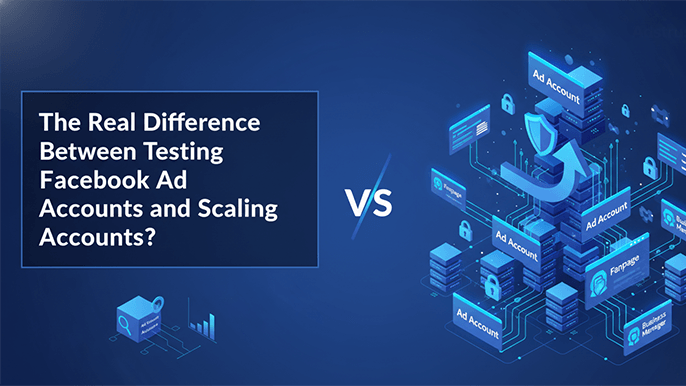
If you already understand the basics of account structure, this article explains the real difference between testing accounts and scaling accounts, why Facebook testing accounts vs scaling accounts should not be judged by the same standard, and what usually goes wrong when advertisers blur that line.
For broader context, it helps to read How Facebook Evaluates Ad Account Trust
How to Scale from $250 Shared Accounts to No-Limit Environments, and Why Some Facebook Ad Accounts Stay Limited for Too Long.
Different Facebook ad accounts are built for different roles

This is the first point many advertisers miss. A Facebook ad account is not automatically a scaling asset just because it can run ads.
Some accounts are more suitable for controlled testing, early validation, cautious warm-up, or smaller campaign exploration.
Others are better positioned for broader, more stable execution once the business is ready to operate at that stage.
That means the real difference between a testing account and a scaling account is not only spend level.
It is role. If you misunderstand the role of the account, you usually misunderstand what “good performance” should look like as well.
A testing Facebook account is usually about learning, not carrying long-term pressure

A testing-oriented Facebook ad account is typically used to explore.
It may be used to test offers, audiences, creatives, angles, or market response in a more limited and cautious way.
The goal is not to force maturity too early. The goal is to learn without asking the account to behave like a fully established scaling asset before it is ready.
That is why a testing account often looks lighter, slower, and more controlled in its early pattern.
Inside the wider Meta advertising system, that can be completely normal.
The problem begins when advertisers expect a testing account to prove long-term scale too early.
A scaling account is expected to show a different kind of maturity
A scaling-oriented Facebook ad account is not just a bigger version of a testing account.
It is usually expected to support stronger continuity, more believable spending rhythm, and a more stable operating pattern over time.
A scaling account should look like an asset being used for ongoing execution, not just for controlled experimentation.
That difference matters because Meta is not only seeing spend. It is seeing behavioral identity.
A testing account that is treated like a scaling account often looks immature.
A scaling account that still behaves like a testing asset often struggles to build the trust the advertiser expects.
Meta reads behavior, not just labels
Advertisers often talk about testing accounts and scaling accounts as though those names alone define the asset.
Meta does not work that way.
Meta reads what the Facebook ad account actually does.
It looks at spending rhythm, continuity, payment behavior, connected assets, and the wider environment around the account.
If the account behaves like a cautious testing setup, Meta will tend to read it that way.
If it behaves like a more stable operational account, the trust pattern may develop differently.
This is one reason How Facebook Reviews Payment Behavior in Ad Accounts matters here.
Billing behavior is part of what helps define whether an account feels temporary, cautious, stable, or ready for stronger continuity.
The mistake is not testing or scaling. The mistake is mixing the two.
Testing is not bad. Scaling is not automatically better. The real problem is confusion between the two roles.
A business may expect scaling outcomes from an account that is still being used in a testing pattern.
Or it may keep a potentially strong account trapped in permanent testing behavior while expecting trust to grow anyway.
In both cases, the issue is not the account category by itself. The issue is mismatch between role and expectation.
That mismatch is one of the quiet reasons many Facebook ad accounts stay stuck.
Testing accounts usually live inside a different operating rhythm
A testing account tends to have a lighter rhythm. Campaigns may be shorter. Budget movement may be more cautious. Decision cycles may be faster.
The account may be used to learn before the business commits heavier infrastructure or deeper continuity. In that context, a more limited structure can still make sense.
This also connects with AdsTrust’s positioning around Facebook ad accounts share $250 daily limit, which is framed for testing, warming, and controlled growth rather than for maximum scaling from the start.
That product logic only makes sense if the advertiser understands the difference between early-stage account roles and later-stage account roles.
A testing account is not weak just because it is cautious. It is weak only when the business misunderstands what it is for.
Scaling accounts usually need stronger system support
A scaling account rarely succeeds on account behavior alone.
It usually needs stronger support from the wider Meta infrastructure.
That includes the right Business Manager, the right Facebook fanpage, more believable payment behavior, and a broader system that looks ready for continuity rather than experimentation.
This is why How Facebook Fanpages Affect Ad Account Stability and Can a Strong Business Manager Fix a Weak Facebook Ad Account? both matter here.
A scaling account is rarely just an account. It is usually a system-supported role inside a more mature environment.
If the environment still looks fragile, the account may never fully behave like a stable scaling asset.
Shared account environments often fit testing more naturally at first
This is another distinction many advertisers overlook.
A shared Facebook ad account can be useful for access, controlled deployment, or early-stage activity, but that does not automatically make it the right place for long-term scaling expectations.
The logic of Shared Ad Accounts vs Owned Ad Accounts matters here because ownership and role often shape what kind of growth path is realistic.
Some shared environments are very useful for testing and transition.
But a business that wants deeper continuity may eventually need a structure better suited to long-term scaling rather than perpetual experimentation.
That is also why What Makes BM2500 Shared Ad Accounts Different belongs in the same cluster.
Not all shared environments carry the same role, capacity, or maturity logic.
Facebook testing accounts vs scaling accounts often differ in trust expectations
A testing account does not need to look fully mature immediately. A scaling account usually does.
That does not mean a testing account is outside the trust model. It means the threshold of expectation is different.
A testing account may still be in an earlier stage of learning, while a scaling account is expected to look more stable, more coherent, and more believable over time.
The problem appears when advertisers want scaling-level flexibility from an account that still sends testing-level signals. In that case, frustration is almost guaranteed.
The transition matters more than the label
The most important stage is often the one between testing and scaling.
A Facebook ad account does not become a scaling account because the advertiser decides it should.
The transition usually depends on whether the account, the page, the payment behavior, and the wider environment all begin to support a more stable role together.
That is why How to Scale from $250 Shared Accounts to No-Limit Environments is an important companion article.
The move from testing to scaling is not simply about pushing more spend. It is about the whole system becoming more believable.
What serious advertisers usually understand earlier
Experienced advertisers do not expect every Facebook ad account to do everything.
They understand that some accounts are for learning, some are for validation, and some are for sustained execution.
They also understand that each role creates different expectations around spend, continuity, and supporting infrastructure.
That is a calmer way to build.
Instead of forcing every account to become a scaling asset, they match the account to the stage and let the broader Meta advertising system evolve with that role in mind.
A weak outcome often comes from using the right asset for the wrong purpose
This is one of the simplest ways to explain recurring frustration.
A business may use a testing account and then feel disappointed that limits remain low, trust grows slowly, or stability never becomes strong enough for larger execution.
But the problem may not be failure. The problem may be role confusion. The same happens in reverse.
A business may try to use a potentially stronger account for cautious, fragmented testing so long that the account never develops a believable scaling identity.
In both cases, the account is not necessarily wrong. The purpose is.
Final Thoughts
So, what is the real difference between testing accounts and scaling accounts?
Usually, it is the role they are meant to play inside the Meta advertising system.
A testing Facebook ad account is often there to learn, validate, and move carefully.
A scaling account is expected to carry more continuity, stronger trust signals, and a more mature operating pattern over time.
The mistake is not using one or the other. The mistake is expecting them to behave the same way.
Once that difference becomes clear, account choice, infrastructure choice, and growth expectations usually become much easier to manage.
Need stable, verified ad accounts? Browse our Facebook ad accounts ($50 to No-Limit), tested before delivery with a replacement warranty.