Some Facebook ad accounts stay limited far longer than advertisers expect.
At first, that feels confusing. The account is active. Campaigns are running. Nothing looks obviously broken.
But the Facebook ad account spending limit does not improve, flexibility remains low, and the account never seems to move into a healthier stage inside the wider Meta advertising system.
That usually happens for a reason.
If you already understand the basics of Facebook ad account structure
This article explains why some Facebook ad accounts stay limited for too long
What Meta is likely reading from that pattern, and why the real issue is often bigger than the ad account itself.
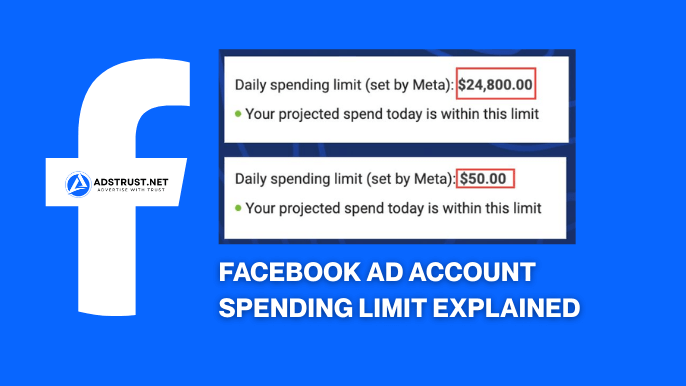
For broader context, it helps to start with Facebook Ad Account Spending Limit Explained and the earlier roadmap article on Facebook Ad Account Disabled or Limited? What to Do Next.
A limited Facebook ad account is usually a Meta trust signal
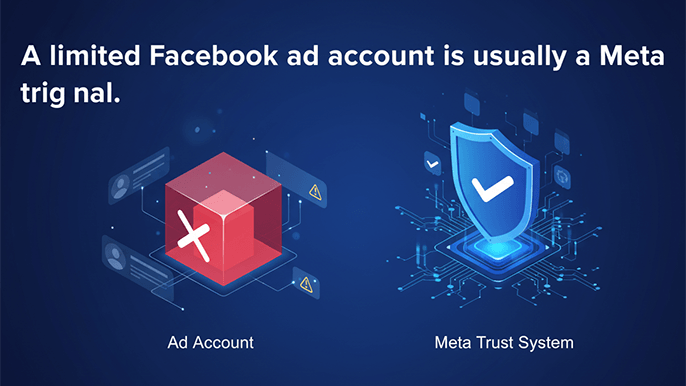
A lot of advertisers treat a limited Facebook ad account like a technical inconvenience.
In practice, these limits usually reflect trust.
Meta does not look at a Facebook ad account only as a place where campaigns run. It looks at the account as part of a wider operating system.
That includes billing behavior, campaign rhythm, connected assets, historical stability, and how believable the whole Facebook advertising environment looks over time.
When a Facebook ad account stays limited for too long, it usually means that trust is not growing the way the advertiser assumes it should.
That does not always mean the account is bad. It often means the system around it is not giving Meta enough reasons to increase confidence.
Time alone does not strengthen a Facebook ad account
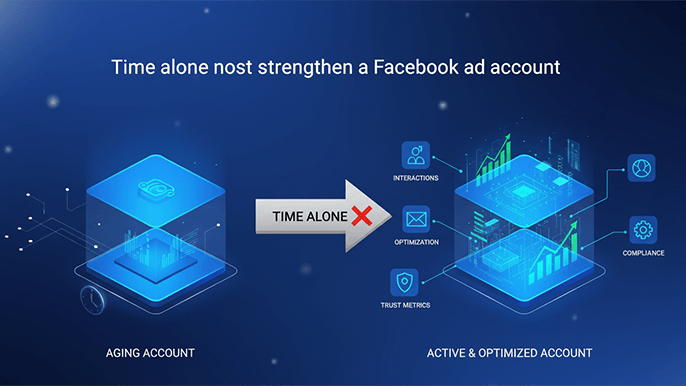
One of the most common misunderstandings is the belief that a Facebook ad account will naturally become stronger if it simply exists long enough.
That is not how Meta ad account maturity usually works.
Some Facebook ad accounts stay limited because they are active without becoming more trustworthy.
They may spend a little, pause often, restart unpredictably, or operate in a way that never builds a stable pattern.
From the advertiser’s perspective, time has passed. From Meta’s perspective, the account still does not look consistent enough to deserve more flexibility.
Maturity is usually earned through believable behavior, not passive age.
That is also why the difference between testing activity and real operational growth matters.
limited Facebook ad account that keeps behaving like a temporary testing account often stays treated that way.
Weak Meta payment behavior slows Facebook ad account trust growth
Payment behavior is one of the quiet signals advertisers often underestimate.
A Facebook ad account does not need dramatic payment failure to look weak. Small inconsistencies can be enough to slow trust development.
Billing patterns that look unstable, awkward spending rhythm, repeated interruptions, or behavior that suggests poor operational discipline can all keep a Meta ad account from progressing.
This connects directly with the roadmap topic Facebook Ads Accounts Explained: Limits, Sharing & Scaling
A Facebook ad account may look fine at the campaign level while still sending weaker signals through billing behavior.
That is why some Facebook ad accounts stay limited for too long even when the ads themselves are not the obvious problem.
The Facebook ad account may be sitting inside a weak environment
Sometimes the Facebook ad account is not the real issue.
The wider Meta account structure around it is.
A Facebook ad account does not operate in isolation.
Its trust can be influenced by the Business Manager, connected Facebook fanpage, payment history, and the overall quality of the system it sits inside.
If the surrounding environment looks unstable, the account may struggle to gain trust even if nothing dramatic is going wrong inside the account itself.
This is one reason the relationship between accounts and infrastructure matters so much.
If you have not already read Facebook Ad Account vs Business Manager, that distinction is important here.
The ad account may be carrying limitations that are partly shaped by the structure above it.
A weak environment often prevents a decent Facebook ad account from becoming a strong one.
Some Facebook ad accounts never move beyond testing behavior
This is another pattern that keeps Facebook ad accounts limited.
The account may be active, but everything about its behavior still looks temporary.
Campaigns come and go too quickly. Spending stays cautious without becoming stable.
There is no clear sign that the account has entered a more mature operating stage inside Meta.
As a result, Meta may continue treating it as a low-trust or early-stage advertising environment because that is exactly how it behaves.
This is why the roadmap article Why Facebook Ad Accounts Get Restricted matters.
Some advertisers think they are slowly scaling, but the Facebook ad account still looks like it is testing without conviction.
An account that keeps sending testing signals may stay limited much longer than expected.
Many advertisers push Facebook ad account growth before the base is ready
There is a quieter version of scaling mistakes that does not always create an outright restriction, but still keeps the account trapped.
The advertiser wants more spend, more flexibility, or a higher ceiling, but the Facebook ad account has not built the kind of operating pattern that supports that next step.
Instead of developing gradually, the business keeps pressing on the limit itself.
That usually leads to frustration.
A limit is often not the problem by itself. It is the result of Meta not seeing enough evidence that the next stage would be safe.
This is why How to Increase Facebook Ad Account Spending Limit should always be read carefully.
The real answer is usually less about forcing an increase and more about understanding why trust is not progressing.
Some Facebook ad accounts were never positioned for long-term stability
Not every Facebook ad account is built for the same role.
Some accounts are used for testing. Some are used for short-term campaign execution.
Some are part of a broader shared environment. Others are expected to support long-term brand growth.
When advertisers confuse those roles, they often expect the wrong behavior from the wrong account.
This is especially relevant when comparing Shared Ad Accounts vs Owned Ad Accounts.
A shared Facebook ad account can be useful, but its role, control model, and growth path may be different from an account built as part of a long-term owned Meta advertising system.
An account can stay limited for a long time simply because the advertiser expects it to evolve into something it was never structurally positioned to become.
Facebook fanpage quality can influence ad account stability
A lot of advertisers look at Facebook ad account limits without looking at the page behind the ads.
That is a mistake.
The Facebook fanpage connected to the account can influence how stable the whole advertising setup feels.
A weaker page environment can hold the system back, especially when the Facebook ad account itself is still trying to build trust.
This is exactly why the roadmap includes How Fanpages Affect Ad Account Stability.
If the page layer is weak, the Facebook ad account may stay capped in practical terms even when the advertiser keeps waiting for it to improve.
A stronger Meta Business Manager does not always rescue a weak Facebook ad account
Some advertisers respond to a weak or limited Facebook ad account by trying to put it under a stronger Meta Business Manager.
Sometimes that helps the surrounding structure. But it does not automatically transform the account itself.
That is why the roadmap question Can a Strong BM Fix a Weak Ad Account? matters.
A stronger Business Manager can improve system quality, but it cannot instantly erase weak history, weak behavior, or weak trust signals already attached to the Facebook ad account.
A limited account often stays limited because advertisers overestimate what infrastructure alone can repair.
Long-term Facebook ad account limits usually point to deeper structural signals
This is common in real operations.
The advertiser believes the Facebook ad account is maturing because it has survived.
Meta may see something else entirely: stop-start behavior, uncertain pacing, inconsistent value, weak supporting assets, or a system that still looks cautious and underdeveloped.
That mismatch creates long periods where the account feels stuck.
In many cases, the account is not held back by one dramatic problem.
It is being slowed by a collection of smaller signals that never add up to enough trust.
What these long-term Meta limits usually reveal
When a Facebook ad account stays limited for too long, the limit is often telling you something important.
It may be revealing weak payment behavior.
It may be exposing a fragile Business Manager or Facebook fanpage environment.
It may be showing that the account still behaves like a testing asset.
It may be confirming that the business is pushing for scale before the full Meta infrastructure looks ready.
The limit is not always the disease.
Sometimes it is the symptom.
That is why serious advertisers do not only ask how to remove the limit.
They ask what the limit is telling them about the Facebook ad account and the infrastructure around it.
Final Thoughts
So, why do some Facebook ad accounts stay limited for too long?
Usually because trust has stopped growing, even if activity has not.
Meta is not only watching whether the account is alive.
It is watching whether the Facebook ad account is becoming more believable, more stable, and more suitable for the next stage.
If that progress does not happen, the limit often remains in place much longer than the advertiser expects.
The important thing is not to treat that limit as random.
It usually reflects something real about the way the Facebook ad account is behaving, the system it sits inside, or the role it is actually serving.
Once you understand that, the right next step becomes much clearer.
Need stable, verified ad accounts? Browse our Facebook ad accounts ($50 to No-Limit), tested before delivery with a replacement warranty.