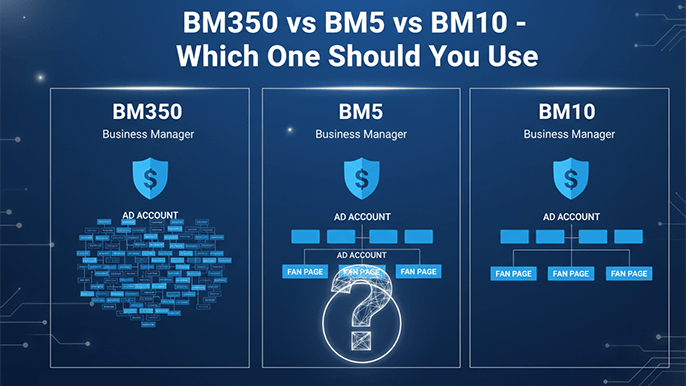

A lot of advertisers compare BM350 vs BM5 vs BM10 as though they are just bigger or smaller versions of the same tool.
That is usually where the mistake begins.
A Facebook Business Manager should not be chosen only by number, ad account count, or spending-limit language.
It should be chosen by stage. If the BM does not match the business you actually have
The structure gets harder to manage, growth becomes less stable, and the system starts carrying pressure it was never designed to hold.
If you need the broader foundation first, start with the main Facebook Business Manager guide and the live article Facebook Business Manager Spending Limits Explained.
This article answers the narrower decision question: BM350 vs BM5 vs BM10 – which Business Manager should you use, and what each option is really built to support.
The wrong way to compare Facebook BM350, BM5, and BM10

The most common mistake is simple.
Advertisers compare these Business Managers as though the only difference is room. More ad accounts. Bigger-looking structure. Higher-looking potential.
AdsTrust’s BM guide warns directly against that mindset. It says BM numbers describe capacity, not resilience, and that larger Business Managers can collapse faster when advertisers choose them for the wrong reason or use them without enough structural discipline.
So the real comparison is not “Which one is biggest?” It is “Which one matches the stage I am actually in?”
BM350 is usually for controlled entry, not real scaling

A BM350 is a very specific kind of starting structure.
AdsTrust’s BM350 product page describes it as a 1 ad account BM with a $25–$50 limit, and notes that additional ad account capacity can unlock only after ad spend and payment history develop.
That tells you immediately this is not broad scaling infrastructure. It is a controlled entry-stage BM.
That makes BM350 useful when the business still needs simplicity, caution, and a smaller environment to learn inside.
It does not make BM350 a good fit for advertisers who already need structured campaign separation or more serious asset handling.
The mistake is not buying BM350. The mistake is expecting BM350 to carry a scaling role it was never meant to carry.
BM5 usually fits advertisers entering structured growth
A BM5 sits in a different stage.
AdsTrust’s BM5 page describes BM5 as a Facebook Business Manager with five advertising accounts that allows advertisers to distribute campaigns logically instead of forcing everything through one ad account.
The page also emphasizes that each account can be warmed independently, helping Meta read more consistent behavior while reducing system risk.
That is a strong clue about intended use. BM5 is usually for advertisers who are past very early entry, but still need a structure that remains manageable.
It supports controlled expansion better than BM350, while still keeping the environment relatively disciplined.
So BM5 is not “better” than BM350 in absolute terms. It is better for a later stage.
BM10 usually makes sense when the business needs more organized separation
A BM10 pushes the same logic further.
AdsTrust’s BM10 page says BM10 provides ten separate ad accounts, each capable of being warmed independently, and frames the BM around spending limits, warm-up, and scaling discipline rather than brute-force volume.
That tells you BM10 is meant for advertisers who need more structured separation than BM5 comfortably provides.
This usually becomes relevant when one brand is already running multiple serious campaign streams
When the team needs cleaner distribution, or when the business has moved beyond modest structured growth into a more layered operating phase.
Again, the point is not that BM10 is automatically stronger. The point is that BM10 suits a more complex stage.
What Facebook BM350, BM5, and BM10 each reveal about business stage
This is where the comparison becomes useful.
A business looking at BM350 vs BM5 vs BM10 is usually not only choosing a BM. It is revealing what kind of operation it is trying to build.
If the business is still learning, validating, and operating cautiously, BM350 often makes more sense.
If the business has entered more deliberate multi-account growth, BM5 usually becomes more natural.
If the business already needs broader separation and more organized asset handling, BM10 may be the cleaner fit.
This is why BM choice should be diagnostic. It should reflect reality, not ambition.
A bigger BM does not protect a weaker operator
This is where a lot of buying decisions go wrong.
An advertiser imagines future scale and buys the larger BM because it feels more advanced.
But if the business still struggles with permissions, warm-up discipline, asset grouping, or ad account stability, a larger BM often makes those weaknesses more expensive instead of less visible.
That is also consistent with the wider BM content already live on AdsTrust.
The BM lifecycle explanation says different Business Managers serve different purposes based on trust level, spending behavior, and long-term intent.
In other words, the wrong BM does not only waste money. It can also distort the way the whole Meta structure develops.
Which Business Manager should you use if you are still early?
If you are still in a cautious phase, the answer is usually not BM10. It is often not even BM5.
A business that still needs a very controlled environment may be better served by BM350 or even a more basic BM entry structure such as BM1
Depending on what kind of ad account capacity and risk exposure it can realistically handle.
AdsTrust’s BM1 page positions it clearly as a safer testing setup before scaling.
That matters because many “scaling problems” are really stage problems.
The operator is trying to use a later-stage BM before the business has earned the need for it.
Which Facebook Business Manager should you use if you are already structured?
If the business is already showing stable behavior, cleaner campaign separation, and a need for more organized growth, BM5 or BM10 can both be logical.
The real question is where the pressure sits. If the system mainly needs more room without becoming too layered, BM5 is often enough.
If the system already needs stronger separation and a more developed structure, BM10 may be the better fit.
This is exactly why the live article Why Facebook Business Manager Gets Disabled matters here.
A BM that is too large for the current level of discipline can become unstable faster than a smaller one that fits the operator properly.
The hidden cost of choosing the wrong BM Facebook stage
The cost is not only financial. A mismatched Facebook Business Manager creates structural noise.
Access becomes harder to manage. Assets get grouped poorly. Warm-up is rushed or misunderstood.
The business starts blaming Meta when the real problem is that the BM never matched the stage of the operation.
That is why advertisers should stop asking which BM looks strongest on paper. The more useful question is which BM makes the system cleaner.
What serious Facebook advertisers usually get right
Experienced operators do not chase BM numbers for status. They choose BMs for fit.
They understand that BM350, BM5, and BM10 are not simply ladder steps that everyone should climb as fast as possible.
They are different infrastructure choices for different stages of discipline, segmentation, and growth.
That mindset usually protects them from avoidable mistakes.
And in Meta systems, avoiding the wrong structure early often matters more than buying the “biggest” structure later.
Closing view
So, BM350 vs BM5 vs BM10: which Business Manager should you use?
Usually the one that matches the business you already have, not the one that matches the scale you imagine.
BM350 fits controlled entry. BM5 fits structured early growth.
BM10 fits more organized separation and a more developed operating stage. The mistake is not choosing any one of them.
The mistake is choosing based on size language instead of structural fit. That is usually where BM problems begin.
Running a small agency? See our BM10 Business Manager (10 ad accounts): clean history, fast delivery.