
A lot of advertisers look at BM2500 and see only one thing: A very large number. That is usually the wrong way to read it.
A BM2500 Facebook Business Manager is not simply a bigger version of BM10 or BM50.
If you need the broader foundation first, start with the main Facebook Business Manager guide and Facebook Business Manager Explained.
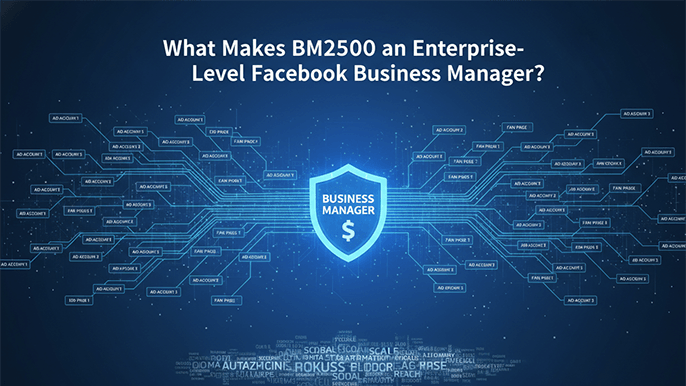
This article focuses on the narrower question: what makes BM2500 an enterprise-level Facebook Business Manager, and why the answer is about operating reality, not just size.
BM2500 Facebook is defined by enterprise role, not just ad account volume

This is the first misunderstanding to clear up. Yes, BM2500 supports a very large number of Facebook ad accounts.
AdsTrust’s live BM2500 Facebook Business Manager product page positions it as an enterprise-grade BM with up to 2500 ad accounts, no daily spending limit at the Business Manager level, priority trust, and limited availability.
Built for agencies and large companies rather than ordinary advertisers.
That distinction matters. A large slot count alone does not make a BM enterprise-level.
What makes it enterprise-level is the kind of business environment it is meant to support.
BM2500 Facebook operates inside a different Meta trust tier

One of the clearest differences is trust environment.
AdsTrust says BM2500 operates within a priority trust framework inside Meta’s system, which can mean higher baseline confidence, stronger account resilience, and clearer escalation paths when problems arise.
The same page also makes an important clarification: this does not mean immunity from policy enforcement.
That is a major reason BM2500 belongs in a different category from normal BM comparisons.
A true BM2500 enterprise-level Business Manager is not only about room. It is also about the trust conditions around that room.
BM2500 is built for parallel execution that smaller BMs are not meant to carry
This is where the enterprise label becomes practical.
According to AdsTrust, BM2500 is designed to let agencies and large companies segment clients or markets cleanly, isolate campaigns without system-wide risk, and operate multiple teams under one trusted entity.
That is a different operating reality from what a BM10 Facebook Business Manager is usually meant to support.
BM10 is positioned around ten ad accounts and structured growth, while BM50 Facebook Business Manager is framed around scalable operations and asset isolation.
BM2500 sits above both because it is built for much wider parallel execution under one business entity.
So when people ask what makes BM2500 enterprise-level, one useful answer is this:
It is built to support complexity that smaller Business Managers are not meant to carry cleanly.
BM2500 is not for most advertisers, and that is exactly the point
This is one of the strongest diagnostic clues.
AdsTrust states directly that BM2500 is not a product most advertisers will ever need.
It describes BM2500 as infrastructure for advertising agencies, large companies running multi-market campaigns, and organizations managing many ad accounts simultaneously, while saying it is not suitable for individual advertisers, small teams, or early-stage testing.
That matters because enterprise infrastructure should feel narrower, not broader. If a BM is genuinely enterprise-level, most businesses should not be using it.
So the real question is not whether BM2500 sounds powerful. It is whether your business is already operating at the level BM2500 was designed for.
BM2500 sits at a different stage in the Facebook Business Manager lifecycle
This is where the stage logic becomes clearer.
AdsTrust’s Facebook Business Manager Explained guide says Business Manager has evolved into a layered advertising infrastructure
Where different BM types serve different purposes based on trust level, spending behavior, and long-term intent.
Read together with the BM2500 product page, the fit becomes obvious. BM2500 is not merely a high-capacity BM.
It sits at the enterprise end of the lifecycle, where the business is no longer just asking for more ad account room.
It is asking for stronger infrastructure quality, cleaner internal separation, and more predictable support conditions.
That is why BM2500 should not be compared to smaller BMs only by number.
Enterprise BM means the surrounding business is already mature
A Facebook Business Manager does not become enterprise-level in isolation.
It becomes enterprise-level when the business around it is already mature enough to use it properly.
The BM2500 page points to that through its use-case language: multi-market campaigns, multiple teams, long-term stability, and larger operational structures.
The broader BM guide also says BM size should be chosen by intended usage, not by fantasy, and warns that larger BMs can become weaker choices when they are mismatched to the operator.
That means many advertisers who think they need BM2500 usually need something else first.
In practice, they often need a cleaner stage-fit structure such as BM5 or BM10 before they even think about enterprise BM logic.
Scarcity is part of what BM2500 represents
Another signal that BM2500 is not normal infrastructure is availability.
AdsTrust says BM2500 is not always available, that these BMs are issued in extremely limited quantities, and that there are periods with no stock at all.
The page explains that this reflects Meta’s cautious approach to granting enterprise-level access.
That matters because enterprise infrastructure is not defined only by internal features.
It is also defined by how rare and controlled access to that infrastructure is.
A product that is always easy to obtain rarely carries the same meaning as one that is scarce because Meta itself treats that layer differently.
BM2500 Facebook is about system design, not prestige
This is where many buyers go wrong.
They read BM2500 as the “highest tier” and treat it like a status upgrade. But AdsTrust does not frame it that way.
It frames BM2500 around scale, trust, support conditions, and business dependence on Meta infrastructure at a serious level.
That is why BM2500 should be seen as a system-design decision.
It makes sense when the business already needs enterprise behavior from its BM. It does not make sense just because the label sounds advanced.
This is also why the comparison logic in the next stage-decision article matters:
BM50 is often the better choice when the business still needs scalable structure, but not full enterprise infrastructure yet.
BM2500 changes what support and escalation look like
This is one of the most practical differences.
AdsTrust says BM2500 typically receives faster review cycles, stronger internal trust signals, and clearer escalation paths inside Meta’s systems.
That means BM2500 is not only carrying more assets. It is operating in a different support reality.
For an actual enterprise advertiser, that changes the business value of the BM significantly.
For a smaller operator, it is usually a sign that they are looking at infrastructure beyond their current stage.
A weak operator can still misuse BM2500
It is important not to romanticize it. A BM2500 may be enterprise-level, but a weak operator can still waste it.
AdsTrust’s broader BM content repeatedly warns that BM capacity is not the same as resilience, and that choosing a BM beyond your real stage creates instability rather than safety.
This is exactly why related pieces like Why Facebook Business Manager Gets Disabled and How Business Manager Controls Ad Accounts still matter here.
A stronger BM can improve the environment. It cannot replace discipline.
What advertisers should ask before thinking about BM2500
Before thinking seriously about BM2500, the better questions are usually these:
Does the business already run multiple teams or markets under one coherent system? Does it already need large-scale ad account isolation?
Does Meta trust and escalation behavior materially affect performance? Is the current BM environment genuinely too small, or just poorly managed?
For some businesses, the real need is not BM2500. It is a stronger trust-oriented base such as a verified Facebook Business Manager, especially when the issue is foundation quality rather than full enterprise scale.
AdsTrust’s verified BM page is careful to describe that offer as a stronger verified base, not a shortcut to instant scaling.
These are more useful questions than asking whether BM2500 is “the best.”
Closing view
So, what makes BM2500 an enterprise-level Facebook Business Manager? Not just the number.
What makes BM2500 enterprise-level is the combination of massive ad account capacity, no BM-level daily spending limit, priority trust framework, clearer escalation paths, limited availability, and a use case aimed at agencies and large companies operating at serious scale.
AdsTrust’s product page and BM lifecycle content both point in the same direction: BM2500 is enterprise infrastructure because it exists for enterprise operations, not for ordinary growth.
That is why most advertisers do not need BM2500. And why the ones who do usually already know why.