
A lot of advertisers compare BM50 vs BM10 the wrong way.
They look at the bigger number, assume BM50 must be the stronger choice, and stop there. That is usually where the mistake begins.
A Facebook Business Manager should not be chosen only by capacity.
It should be chosen by what kind of business structure it needs to hold without becoming unstable.
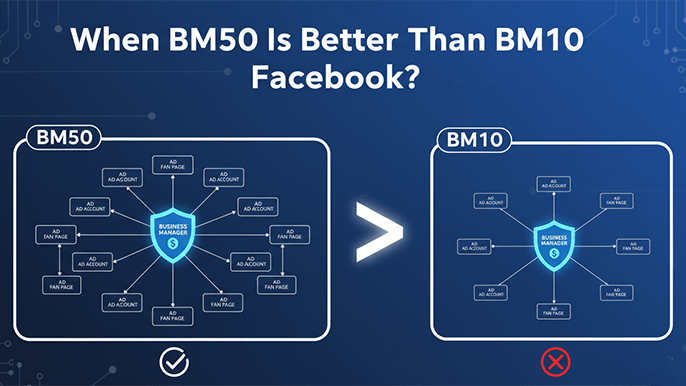
AdsTrust’s BM pages make that distinction clear: BM10 is positioned for cost-efficient scaling and structured asset control, while BM50 is positioned for scalable Meta advertising, asset isolation, and long-term system stability.
If you need the broader BM foundation first, start with the main Facebook Business Manager guide and Facebook Business Manager Explained.
This article answers the narrower decision question: when BM50 is better than BM10, and what signs usually show that BM10 is no longer the right fit.
BM50 is not “better” than BM10 Facebook by default

This is the first thing to make clear. A bigger Facebook Business Manager is not automatically the better Business Manager.
AdsTrust’s BM guide explicitly warns that BM numbers describe capacity, not resilience, and that larger BMs can collapse faster when advertisers choose them for the wrong reason or use them without enough structural discipline.
That means BM50 is only better than BM10 when the business has reached a stage where BM10 is no longer giving enough structural room.
So the real comparison is not “Which one is stronger on paper?” It is “Which one matches the operating shape of the business now?”
BM10 is usually better when the business still needs controlled scaling

AdsTrust’s BM10 Facebook Business Manager page describes BM10 as a 10-ad-account structure built for cost-efficient scaling, structured asset control, and long-term Meta advertising stability.
It also says BM10 is not entry-level, but a mid-tier scaling asset for advertisers who have already passed the testing phase and now need a structured environment to grow.
That tells you what BM10 is really for. BM10 is usually the better fit when the business is already moving beyond small-scale testing, but still wants a structure that remains relatively clean, understandable, and disciplined.
So if the operation still fits inside a controlled scaling stage, BM10 may still be the healthier choice.
Facebook BM50 becomes better when the business needs parallel execution, not just more room
This is the core difference.
AdsTrust’s BM50 Facebook Business Manager page positions BM50 around scalable Meta advertising, asset isolation, and long-term system stability, and explicitly says BM50 exists for advertisers who have already validated funnels and now need infrastructure for controlled expansion.
The page also says BM50 is designed for parallel execution at volume, not just for having a larger number of ad accounts.
That is when BM50 starts becoming better than BM10. Not when the operator wants a bigger number.
When the business actually needs cleaner separation between many moving parts.
BM50 is better than BM10 Facebook when campaign separation becomes a structural need
This is one of the clearest diagnostic signals.
If the business now runs multiple markets, multiple funnels, multiple offers, or multiple client environments at the same time, BM10 may begin to feel cramped.
The problem is not always that BM10 is too small in theory. The problem is that the system starts losing clarity when too many operational layers live too close together.
AdsTrust says BM50 is chosen when advertisers need:
- multiple ad accounts running in parallel
- clear separation between campaigns, clients, or funnels
- reduced risk when one ad account gets flagged
- fewer system rebuilds over time.
That is a very different use case from simply “more room.” It is a separation problem.
Facebook BM50 is better than BM10 when asset isolation becomes more important than simplicity
BM10 still works well when the business values structured growth with relatively low complexity.
But BM50 becomes the better fit when asset isolation starts mattering more than keeping the system small.
AdsTrust uses that exact phrase (asset isolation) in its BM50 positioning.
That usually happens when the business wants to protect itself from chain-reaction instability.
A system with clearer isolation can separate offers, regions, or client environments more safely.
It can also reduce the operational damage when one ad account hits review or becomes unstable.
That is not a luxury use case. It is a maturity use case.
BM50 is better than BM10 when the operator has already outgrown mid-tier BM logic
AdsTrust’s BM50 page says BM50 is particularly valuable for advertisers who have outgrown mid-tier setups and now need long-term infrastructure, not a temporary solution.
That wording matters.
BM50 becomes the better choice when BM10 is no longer failing because it is “bad,” but because the business has moved into a different class of operational pressure.
At that point, the issue is not whether BM10 can technically still function. The issue is whether BM10 is still the cleanest structure for the work being done.
A Business Manager should not only survive. It should still make sense.
BM50 is not better than BM10 when the real problem is discipline
This is where many buying decisions go wrong.
A business starts feeling pressure, assumes the BM is too small, and upgrades to BM50.
But the real issue may not be BM10 at all. It may be weak admin discipline, poor asset grouping, unstable ad account behavior, or a scaling process that still looks messy.
In that case, BM50 usually does not solve the problem. It gives the business more space to mismanage itself.
This fits directly with the broader logic in Why Facebook Business Manager Gets Disabled and How Business Manager Controls Ad Accounts.
A larger BM does not repair weak structure by itself. It only changes the environment around that structure.
BM50 is usually for operators who already know how not to fill it carelessly
This is another sign of stage fit. AdsTrust’s BM50 page says experienced advertisers do not activate all 50 ad accounts at once.
It describes a common practice of starting with only a few ad accounts, gradually adding assets, assigning roles carefully, and maintaining consistent spend patterns so BM50 can build trust gradually instead of triggering review loops.
That tells you BM50 is not meant for operators who think capacity should be used immediately.
It is meant for operators who understand how to expand a system carefully.
If that discipline is not there, BM50 is usually not the better choice yet.
BM50 often makes more sense for agencies and multi-funnel teams
AdsTrust says BM50 is ideal for agencies and advertisers managing multiple campaigns.
It also says BM50 is commonly chosen by agencies managing multiple clients, affiliate teams running parallel funnels, and brands scaling multiple offers.
That is important because it shows where BM50 starts to outperform BM10 in practical terms.
When one business or team is no longer operating like one clean mid-tier growth unit, but more like a layered execution system, BM50 usually makes more sense.
This is especially true if the business already depends on separation, not just growth.
BM10 is still better when the business is scaling, but not yet layered enough
It is also important to say the opposite clearly. A lot of businesses are growing, but not yet layered enough for BM50.
They may have passed testing. They may need more than one ad account. They may already be warming separate accounts responsibly.
But if the structure still feels coherent under BM10, moving to BM50 too early usually adds complexity before the business is ready to use it well.
That is why BM50 should be chosen because BM10 is no longer structurally clean, not because BM50 sounds more advanced.
A useful way to decide between BM50 and BM10 Facebook
The cleanest diagnostic question is this: Do you need more accounts, or do you need more separation?
If the business mostly needs room inside a still-manageable growth stage, BM10 may remain the better fit.
If the business now needs real campaign isolation, cleaner internal segmentation, and a longer-term parallel structure, BM50 is usually the better answer.
This also connects naturally with How Many Facebook Ad Accounts Can One BM Really Handle?
Slot count matters less than whether the structure still holds together cleanly.
Closing view
So, when is BM50 better than BM10?
Usually when the business has moved beyond controlled mid-tier scaling and now needs true separation, asset isolation, and a stronger structure for parallel execution.
BM10 is still a very good fit for disciplined growth. BM50 becomes better when the operation is no longer just growing, but layering.
AdsTrust’s product logic makes that distinction clear: BM10 is a scaling asset, while BM50 is infrastructure for wider-scale system management.
The mistake is not choosing BM10 or BM50 Facebook. The mistake is choosing BM50 before the business has earned the need for it.