
A lot of people imagine agency Facebook Business Manager setup the wrong way.
They think agencies simply buy a bigger BM, add more ad accounts, and start scaling.
That is not how real Facebook Business Manager systems for agencies are built.
A serious agency BM system is not just one large structure. It is a controlled operating design built around separation, access discipline, client isolation, asset logic, and stage fit.
AdsTrust’s BM ecosystem points in that direction very clearly: different BMs serve different roles based on trust level, spending behavior, and long-term intent, not just size.
If you need the broader BM foundation first, start with the main Facebook Business Manager guide and Facebook Business Manager Explained.
This article focuses on the narrower question: how agencies build Facebook Business Manager systems, and what those systems usually include when they are designed well.
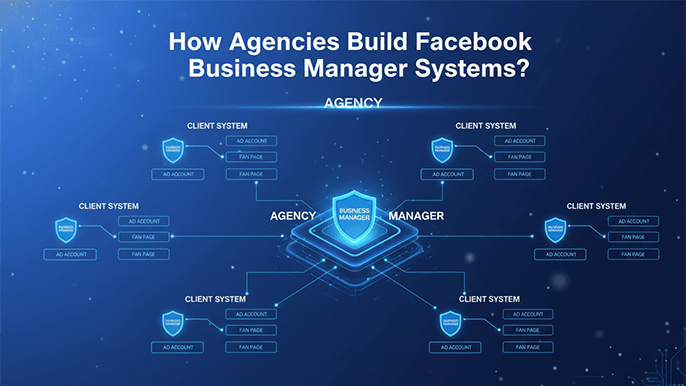
Agencies do not build one BM. They build a BM system

This is the first distinction that matters.
A single Facebook Business Manager is only one layer. An agency system is usually made of multiple connected decisions:
what BM stage to use, how many ad accounts to separate, where pages sit, which profiles support access, and how risk is contained so one client or funnel does not damage everything else.
That is why agencies with real infrastructure do not think only in terms of “one BM.” They think in terms of architecture.
A BM system is really a control model. It decides how the agency will operate under pressure.
The first job of an agency BM system is separation

Agencies usually fail when too many things sit too close together. Client assets mix together. Team access becomes messy.
One weak ad account affects work that should have stayed isolated. The whole structure begins to feel like a pile of connected risk instead of a controlled environment.
This is exactly why asset isolation appears so often in AdsTrust’s BM product logic.
The BM50 Facebook Business Manager page positions BM50 around scalable Meta advertising, asset isolation, and long-term system stability, and says agencies often choose it when they need multiple campaigns, clients, or funnels running in parallel.
That tells you something important. Agencies do not build BM systems only for scale. They build them for controlled separation.
Agencies usually choose BM stage by operational pressure, not by status
A serious agency does not begin by asking which BM sounds most impressive. It asks what kind of pressure the system needs to carry.
A smaller or earlier-stage agency may still function well inside a BM5 Facebook Business Manager or BM10 Facebook Business Manager, especially when the team is structured but not yet deeply layered.
AdsTrust positions BM5 around structured scaling and multi-campaign control, and BM10 around cost-efficient scaling, structured asset control, and long-term Meta advertising stability.
A larger or more mature agency may need BM50 because the system now depends on wider client separation and parallel execution.
At the highest end, BM2500 Facebook Business Manager exists for enterprise-scale operations, but AdsTrust says directly that BM2500 is not a product most advertisers will ever need.
That is the key diagnostic principle. Agencies build BM systems by stage fit, not by ego.
Client isolation is usually more important than raw ad account count
Many people outside agency operations misunderstand this completely. They assume agencies mainly care about how many ad accounts a BM can hold.
In practice, what agencies often care about more is whether those ad accounts can stay separated cleanly enough to protect client operations.
This connects directly with How Many Facebook Ad Accounts Can One BM Really Handle?
The raw slot count is only part of the picture. What matters more is whether the BM can hold those accounts without losing structural clarity, access discipline, or asset logic.
A real agency system is not measured only by volume. It is measured by containment.
Agencies build around access control much earlier than most advertisers
A weak agency BM system usually breaks at the access layer before anything else.
Too many people get admin rights. Roles are assigned carelessly. One person’s convenience becomes system-wide exposure.
Over time, the Facebook Business Manager stops looking like a stable business environment and starts looking like a temporary workspace.
That is exactly the kind of pattern Meta tends to distrust. It also connects directly with Why Facebook Business Manager Gets Disabled.
A BM system that is sloppy at the access layer usually becomes fragile long before the agency notices the deeper problem.
So agencies that build well usually take access seriously from the beginning. They treat roles as infrastructure, not just permissions.
Agencies often pair Business Manager design with profile strategy
This is one of the quieter but very real parts of system building.
A BM system does not only depend on the Business Manager itself. It also depends on who is entering and managing the structure.
AdsTrust’s BM50 page says professionals commonly assign roles carefully using aged profiles and maintain consistent spend patterns so the system can grow gradually without triggering unnecessary review loops.
That matters because an agency system is not just a BM map. It is a behavior map.
If the profiles, roles, and access rhythms are weak, the BM system above them often becomes weaker too.
Strong agency BM systems are built for client continuity, not just execution speed
A short-term operator may care mostly about running campaigns. A real agency has to think beyond that.
It needs a system that can survive client changes, asset changes, team changes, and future scaling without rebuilding everything from zero.
That is one reason AdsTrust positions verified Facebook Business Manager as a stronger trust-oriented base often used by agencies building stable client infrastructure.
The verified BM page says agencies commonly use verified BMs for long-term brand advertising and stable system growth under Meta’s trust framework.
That tells you something important. Agencies do not only build BM systems for immediate use. They build them for continuity.
Agency BM systems usually separate testing from long-term client scaling
This is another important design choice.
When agencies push testing activity and long-term scaling activity too close together, instability spreads faster.
The better systems usually separate early experimentation from more established client operations.
That does not always mean a completely different BM for every situation, but it does mean the agency is thinking intentionally about what belongs together and what does not.
This also connects naturally with the logic in How Business Manager Controls Ad Accounts. The BM is not just holding ad accounts. It is shaping the environment those accounts operate inside.
A testing-heavy environment and a mature scaling environment often should not be treated as the same system.
Most weak agency BM systems are really just collections of assets
This is the difference between buying infrastructure and building a system.
A weak agency may own several BMs, multiple pages, many ad accounts, and plenty of access points, but still have no real system.
Why? Because the assets are not organized around clear roles. They are only accumulated.
That is where many agencies get stuck. They think size means structure. It does not.
A BM system becomes real only when each layer has a role, each role has boundaries, and the whole environment can still be explained clearly six months later.
A healthy agency BM system usually looks boring from the outside
This is often the biggest surprise. Well-built systems do not usually look dramatic. They look orderly.
The right BM fits the stage. Client separation makes sense. Roles are stable.
Pages and ad accounts belong where they should. Scaling happens with intention, not impulse. The system does not depend on constantly rebuilding itself.
That kind of boring structure is often exactly what allows agencies to scale more safely over time.
And in Meta environments, boring usually survives longer than clever.
What agencies should ask before expanding a BM system
Before adding more BM capacity or more ad account layers, the better questions are usually these:
Is the current system already clear? Are clients isolated well enough?
Is access discipline strong enough to support expansion? Does the next BM tier solve a real structural problem, or only a feeling of pressure?
These are much better questions than “Should we get a bigger BM?”
They also connect with the earlier decision article When BM50 Is Better Than BM10. Bigger BM logic only helps when it solves a real system need.
Closing view
So, how do agencies build Facebook Business Manager systems? Not by stacking random assets under a bigger BM.
They build BM systems through separation, access discipline, client isolation, stage-fit Business Managers, and infrastructure choices that can survive long-term pressure.
AdsTrust’s BM product logic and BM guide point to the same conclusion: different BM stages exist because different businesses need different levels of control, trust, and structural complexity.
A real agency BM system is not just a bigger setup. It is a cleaner one.
Need a clean, verified Business Manager? Browse our Facebook Business Manager packages (BM1–BM2500), tested before delivery with a replacement warranty.