
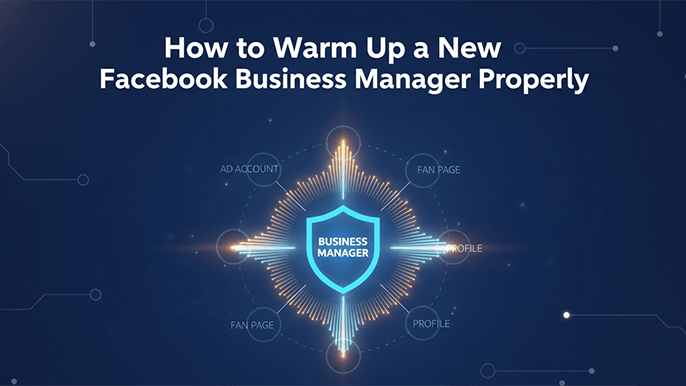

A lot of advertisers damage a new Facebook Business Manager before it ever gets a fair chance to become stable.
They set it up, add assets quickly, move access around, and assume the BM is now ready to carry real pressure. That is usually where the trust problem starts.
A new Meta Business Manager is not just waiting for ad spend. It is being observed for structure, role clarity, and behavioral consistency.
AdsTrust’s BM guide says warm-up is not mainly about “spending slowly.”
It is about teaching Meta who you are through gradual asset attachment, stable user roles, predictable behavior patterns, and controlled activity growth.
Skipping that phase sends one clear signal: instability.
If you need the broader BM foundation first, start with the main Facebook Business Manager guide and Facebook Business Manager Explained.
This article answers the narrower question: how to warm up a new Facebook Business Manager properly, and what usually goes wrong in the first phase.
A new Facebook Business Manager should begin with one clear role

Most warm-up problems begin before the first ad ever runs.
The BM starts life without a clear job. It is used as a storage place for future ideas, random assets, and access that “might be needed later.”
That makes the structure harder to trust from the beginning.
A new Facebook Business Manager should start with one controlled purpose. Is it for testing? Early structured growth? A longer-term trust-first base?
AdsTrust’s BM lifecycle guide says different BMs serve different purposes based on trust level, spending behavior, and long-term intent, which means warm-up should reflect the stage the BM is actually meant to serve.
Warm-up works best when the BM is being introduced as one believable business environment, not as unfinished inventory.
Meta is reading behavior patterns long before the BM feels “active”

This is one of the biggest misunderstandings around BM warm-up.
A lot of advertisers think nothing important is happening until campaigns scale.
But AdsTrust’s BM guide says Meta evaluates Business Managers at the BM level using factors such as account behavior, payment history, business verification status, and long-term usage patterns.
That means Meta is already learning from:
- how assets are attached
- how user roles are assigned
- how quickly the structure changes
- whether the BM behaves like a calm business environment or a rushed setup
So a new BM is never “neutral.” It is either building trust or weakening it.
The safest warm-up starts smaller than most advertisers want
This is usually the first practical correction people need. A new Facebook Business Manager should not begin by trying to prove how much it can hold.
It should begin by proving it can stay coherent. AdsTrust’s BM guide says a healthy warm-up phase includes gradual asset attachment, stable user roles, and controlled activity growth.
That is why early-stage BM options exist in the first place.
A BM1 Facebook Business Manager is positioned as a one-ad-account environment for safe Facebook ads testing before scaling
With the product page explicitly saying one-account structure sends cleaner, more consistent signals and is often used for early testing and warm-up.
A smaller starting structure is not weakness. It is often better behavioral discipline.
Stable user roles matter more than people think
One of the fastest ways to make a new Facebook Business Manager look unstable is messy access behavior.
Too many users, too many role changes, or too many early admin actions make the BM feel improvised.
AdsTrust’s BM guide lists stable user roles as a core part of healthy warm-up and warns that inconsistent access patterns are one of the clearest ways a BM starts losing trust.
This matters because Meta is not only reading what the BM contains. It is reading whether the people around it behave like a real business system.
That is why agencies and more advanced operators usually assign access much more carefully than beginners expect.
If you have not already read How Agencies Build Facebook Business Manager Systems, that access logic becomes much easier to understand.
Gradual asset attachment is part of warm-up, not a separate task
A lot of advertisers treat asset attachment like setup admin work and warm-up like something that starts later.
That split is artificial. AdsTrust’s BM guide directly says healthy BM warm-up includes gradual asset attachment.
In other words, the way you add ad accounts, pages, domains, and other assets is part of the trust story from the beginning.
This is also why a new BM should not be filled just because it has room.
A BM10 Facebook Business Manager may be offered with ten ad accounts and higher spend positioning, but its product page still emphasizes warm-up and scaling discipline, saying experienced advertisers use BM10 to warm accounts gradually instead of forcing aggressive spend.
Capacity does not remove the need for a careful start.
A warm-up plan should match the stage of the BM
This is where many operators create avoidable problems.
They use the same warm-up mindset for every BM, even though the BM types are meant for different stages.
AdsTrust’s BM1 page says BM1 is intentionally built for early-stage testing and warm-up before larger structures.
BM350 is described as a one-ad-account BM with low daily spend limits because Meta applies stricter controls to new Facebook Business Managers, and expands capacity only after trust is established through successful payments and consistent activity.
That stage logic matters. A new BM should be warmed based on what it is for:
- controlled entry
- first structured growth
- trust-first foundation
- later scaling infrastructure
Treating every BM like a ready-made scaling environment usually makes warm-up worse, not faster.
Verification changes the starting position, not the need for caution
A verified BM does not remove the need to warm up properly.
AdsTrust’s Verified Facebook Business Manager page says a verified BM starts from a stronger trust position because the business entity has already been verified, but it also says advertisers often buy a verified BM without ad accounts so they can create them themselves and control account structure, payment methods, spending behavior, and warm-up pace.
That is an important point. Verification improves the foundation. It does not justify rushed behavior afterward.
This is exactly why the related article Why Verified Facebook Business Managers Still Get Restricted matters so much in this cluster.
New Business Managers usually fail when early changes feel too compressed
Most BM warm-up mistakes are not dramatic. They are compressed.
Too many assets appear too quickly. Too many access actions happen too close together.
The BM starts carrying more intention than it has earned trust for. From the operator’s side, it feels efficient. From Meta’s side, it often looks unstable.
AdsTrust’s BM guide says skipping warm-up creates one clear signal: instability, and that Meta reacts to that signal faster than ever.
That is why a proper warm-up is not about speed. It is about believable pacing.
The BM should become predictable before it becomes ambitious
This is one of the simplest ways to think about warm-up.
A new Facebook Business Manager should first look predictable. Stable access. Stable role. Controlled asset logic.
Measured activity. Only after that does it make sense to increase complexity.
This is also where articles like How Business Manager Controls Ad Accounts and How Many Facebook Ad Accounts Can One BM Really Handle?
Become useful. A BM cannot handle complexity well if it has not first shown that it can stay structurally clean.
Predictability is what makes later growth believable.
A strong warm-up is really a trust-building phase
The mistake is to treat warm-up like a waiting period. It is not waiting. It is trust-building.
AdsTrust’s BM product ecosystem keeps pointing back to this idea.
BM5 is framed as a middle ground for advertisers past testing but not ready for larger systems, with each ad account able to be warmed independently.
BM10 is positioned around gradual scaling discipline rather than aggressive early spend.
Verified BM is framed as a stronger base that still requires careful build-out.
That means warm-up is not one trick. It is the phase where the BM starts becoming believable.
What advertisers should review before calling a BM “ready”
Before assuming a new Facebook Business Manager is ready for heavier use, the better questions are usually these:
Does the BM have one clear role? Are user roles stable? Were assets attached gradually and intentionally?
Does the structure feel coherent, or just newly assembled? Has the BM shown predictable behavior long enough to justify more pressure?
These are much better warm-up questions than “How fast can I scale this?”
They also connect directly with Why Facebook Business Manager Gets Disabled.
A lot of BM failures begin with early structure that was never calm enough to earn trust.
Closing view
So, how do you warm up a new Facebook Business Manager properly? Usually by doing less, more carefully.
A new Meta Business Manager should begin with one clear role, stable access, gradual asset attachment, and controlled behavioral growth.
AdsTrust’s BM guide says that is what healthy warm-up looks like, and their BM product logic reinforces the same idea across BM1, BM5, BM10, BM350, and verified BM: good infrastructure is introduced by stage, not forced by ambition.
That is why proper warm-up is not slow for the sake of being slow. It is disciplined for the sake of becoming trusted.
Need a clean, verified Business Manager? Browse our Facebook Business Manager packages (BM1–BM2500), tested before delivery with a replacement warranty.


Great content! Keep up the good work!